

A standard bathroom renovation in Melbourne typically costs between A$20,000 and A$35,000. Where a project lands inside that band comes down to floor area and, far more powerfully, the scope of work involved.
The advice you'll hear most often is to budget by area. Pick a square-metre rate, multiply it by your floor plan, and treat the result as your number. I'd push back on that, because area tells you how much material and labour hours a room needs, and says almost nothing about how many trades have to walk through the door. Two 5 m² bathrooms a few streets apart can land in completely different bands, and the deciding factor is usually whether the toilet moves 400 mm to the left.
That's why the only honest way to read a bathroom quote is by scope and inclusions, not by the headline total. A quote that looks A$9,000 cheaper on paper often isn't cheaper at all. It's the same job with the preparation, waterproofing and waste removal stripped out, waiting to reappear as a variation the day the tiles come off the wall.
Table of Contents
- Typical Bathroom Renovation Costs in Melbourne
- Cost by Scope From Cosmetic Refresh to Full Strip-Out
- Cost Drivers That Move the Final Price
- Why Waterproofing and Plumbing Decide Long-Term Cost
- How to Compare Quotes Line by Line
- When a Cheaper Renovation Costs More Later
- Set Your Budget and Request Itemised Quotes
Typical Bathroom Renovation Costs in Melbourne
For a 5 to 6 m² mid-range renovation with no structural change, the Co-Architecture Melbourne bathroom renovation cost guide puts a planning estimate at A$20,000 to A$32,000, covering replacement finishes, fixtures, waterproofing and straightforward installation. Across a standard 4 to 6 m² bathroom, Melbourne projects are typically budgeted inside a A$20,000 to A$35,000 band. Smaller rooms aren't automatically cheaper, and the table below shows why.
Bathroom renovation planning estimates by room size
| Project type | Floor area | Planning estimate (AUD) | What it usually covers |
|---|---|---|---|
| Standard bathroom, typical Melbourne band | 4–6 m² | A$20,000–A$35,000 | Finishes, fixtures, waterproofing and straightforward installation |
| Standard renovation, Melbourne, no structural change | 5–6 m² | A$20,000–A$32,000 | Replacement finishes and fixtures with no major structural change |
| Ensuite | 3–5 m² | Overlaps a standard bathroom; fixed costs set the floor | Fixed costs for plumbing, waterproofing, electrical work and trades |
| Master ensuite | 9–14 m² | Sits above the standard band on a larger scope | Larger tiling area, more fixtures and more trade coordination |
Read the ensuite row carefully. A compact ensuite can land in the same band as a main bathroom nearly twice its size, and that's not a pricing error. It's the fixed costs showing through. Shrink the room and the plumber still attends, the membrane still gets applied, and the skip still sits in the driveway for a week.
Fixed costs follow the room, not the square metres
Every wet area carries a set of costs that don't shrink with the floor plan. Strip out the area and you still pay for:
- Plumbing rough-in and connection. A licensed plumber attends, sets falls and connects to existing services whether the room is 3 m² or 12 m².
- Waterproofing and substrate preparation. Membrane, primer, bond breakers and curing time scale with wall and floor junctions more than with area.
- Electrical work. Extraction, lighting and any new circuit need a licensed electrician on site.
- Demolition and disposal. A skip doesn't get cheaper because the room is small.
- Compliance documentation. Certificates for waterproofing, plumbing and electrical work are a fixed cost of doing the job properly.
- Trade attendance. Five or six trades each arrive, set up and clean up. That's a fixed toll on a small room.
Planning rule: the floor area tells you the volume of work, not the number of trades. Budget from the fixed costs up, then let area adjust the figure.
Treat every figure in the table as a planning estimate, not a measured average. These bands can't see your subfloor, your asbestos risk or your switchboard.
To use them properly, find your floor area, note whether the room is an ensuite or a main bathroom, then write down which of the fixed costs above apply to your property. Only then compare a quote against its band. A quote that lands well below the band is either a bargain or a document that's missing pages, and the fixed-cost list is how you tell the difference. Ask for demolition, waterproofing, certification and waste removal as their own line items. The cheapest-looking total is usually the one where those lines went missing, and the comparison only gets honest once they're priced back in.
Cost by Scope From Cosmetic Refresh to Full Strip-Out
Scope moves the number further than area ever will. BuildPilot's Melbourne bathroom renovation guide estimates that costs vary by more than threefold across finish levels and layout decisions, with heritage-overlay suburbs adding an estimated 10% to 25% on top, partly through more complex sub-floor waterproofing and possible asbestos disposal. The gap between a footprint-retaining renovation at A$18,000 to A$32,000 and a mid-range full renovation at A$38,000 to A$58,000 isn't contractor pricing. It's plumbing being rerouted, tiles running to the ceiling, and a custom vanity replacing something off the shelf.
Here's how the three tiers sit side by side.
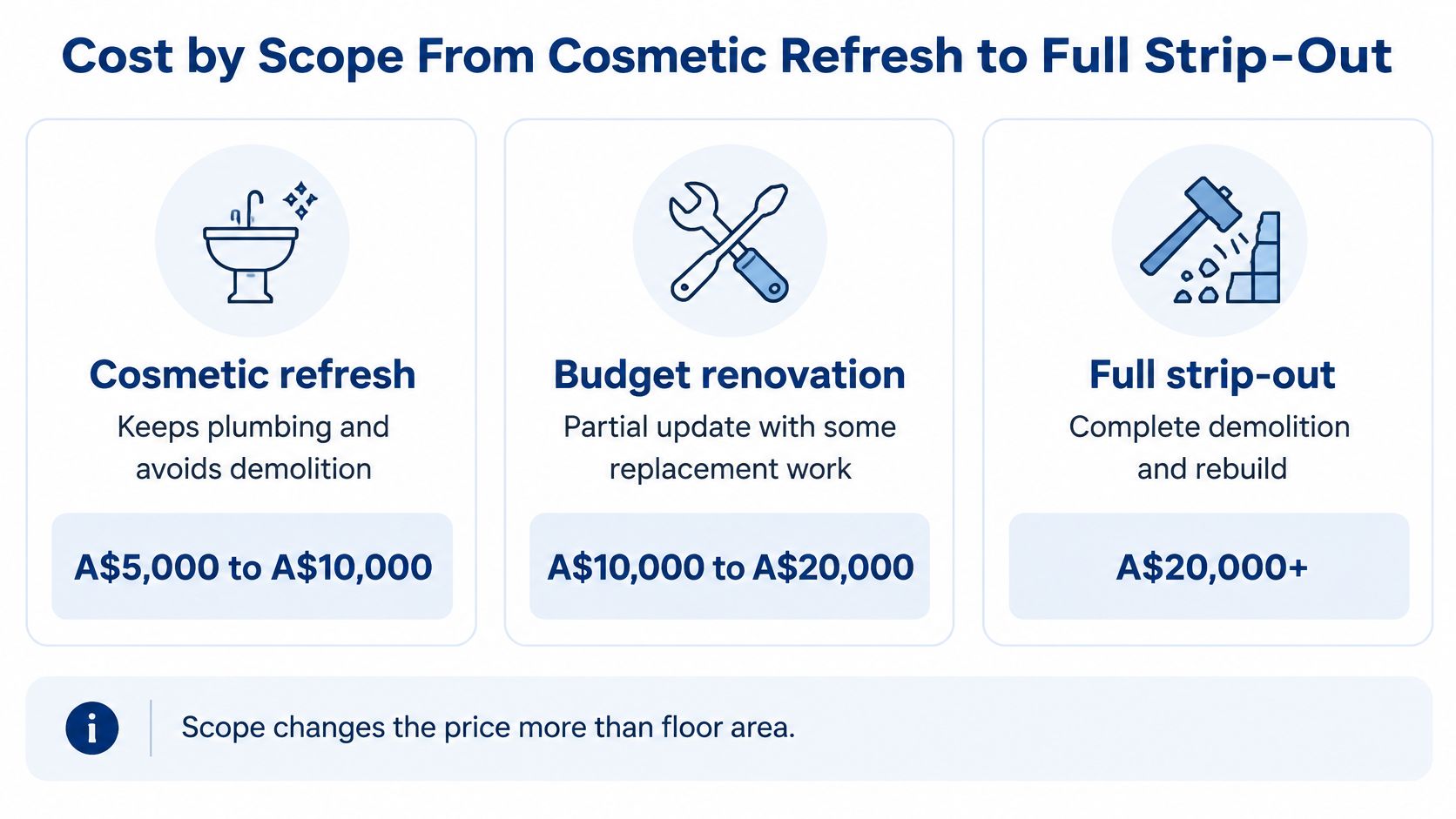
Melbourne bathroom renovation cost by scope and finish
| Scope | Typical cost (AUD) | What the price includes |
|---|---|---|
| Cosmetic refresh, plumbing retained | A$5,000–A$10,000 | Retiling, vanity, tapware and screen with no demolition |
| Budget renovation, existing footprint | A$18,000–A$32,000 | Replacement finishes and fixtures in the same layout |
| Mid-range full renovation | A$38,000–A$58,000 | New plumbing, floor-to-ceiling tiles, quality tapware and custom vanity |
| Premium renovation | A$65,000–A$120,000+ | Stone finishes, freestanding bath, heated floors and architectural design |
The premium row is where stone, a freestanding bath, heated floors or architectural design push a project to A$65,000 to A$120,000 or more. Nothing in that row is a small upgrade. Each item brings its own trade, its own lead time, and its own sequence in the build.
The quick test for which band you're in
Stand in the doorway and answer one question about the toilet, the shower and the floor waste. If all three stay exactly where they are, your project almost certainly belongs in the first two rows. If any one of them moves, you're in the mid-range row or above, and the reason is sequencing.
A cosmetic refresh keeps the plumbing running where it already runs, so the tiler works, then the plumber returns for the tapware. Move a drain and the order changes: demolition, then plumber, then waterproofing, then tiling, then the plumber again to fit off. Each handoff adds a day and a return visit. That's the structural reason a layout change costs more than the same room refinished in place.
The scope bands and the size bands overlap deliberately. A 9 to 14 m² master ensuite done as a footprint-retaining renovation can land in the mid-range scope band, and a 4 m² bathroom with a relocated shower can climb well past it. Scope decides which band applies. Area only nudges the figure inside it.
Cost Drivers That Move the Final Price
Start with the multiplier everyone underrates: scope. MyHomeware's Australian bathroom cost guide places a complete renovation, including demolition, retiling, vanity, tapware, toilet, shower screen and associated trades, at roughly AUD 10,000 to 20,000, with broader full-renovation benchmarks of about AUD 2,300 to 4,600 per m². Run the maths on a 5 to 8 m² room and you get a theoretical AUD 11,500 to 36,800. The top of that range reflects premium finishes, complex detailing and awkward layouts, not extra floor area.
That reconciliation matters. The per-square-metre rate is a sanity check on the scope bands, not a replacement for them. When a rate-based estimate comes in high, the cause is almost always a driver in the table below.
Cost drivers and what raises each one
| Cost driver | Typical effect | What pushes it higher |
|---|---|---|
| Labour | 40–50% of total | Multiple trades in sequence, access constraints and tight timing |
| Waterproofing | A$800–A$1,500 typical | Substrate repairs, many penetrations, floor wastes and hobless showers |
| Heritage-overlay suburb | +10–25% | Complex sub-floor waterproofing and possible asbestos disposal |
| Plumbing relocation | Priced per fixture moved | Moving the toilet, shower or floor waste away from existing locations |
| Electrical upgrades | Priced per circuit added | New circuits for heated floors, extraction fans or lighting |
| Demolition and waste removal | Priced per skip and per hour on site | Disposal fees, substrate replacement and access limits |
Plumbing relocation deserves a second look because it's the driver homeowners trigger casually. Every moved fixture needs a new drainage run, a new set of falls, and floor reinstatement over the old connection. Electrical upgrades work the same way. A heated floor or a higher-extraction fan needs a new circuit pulled back to the board by a licensed electrician, and if the board is full, that's an additional job.
Demolition involves two costs instead of one. There is the tipping fee for the waste, and then there is what the demolition exposes: rotten subfloor, damaged sheeting, outdated wiring that no longer meets standards. That is why the lowest quote can be risky. A small budget for preparation, waterproofing, ventilation, or disposal often leads to unexpected expenses once the room is opened.
Tile area and format do more than material cost. Large-format porcelain over floor-to-ceiling walls takes longer to set out, more adhesive coverage, and more careful cutting around penetrations than a standard splashback-height tile. That's labour hours, and labour sits at the largest single share of the total.
Why Waterproofing and Plumbing Decide Long-Term Cost
Waterproofing is the smallest line on the quote that can produce the largest bill. MyHomeware's small bathroom cost guide puts typical bathroom waterproofing at about AUD 800 to 1,500, with the price rising for substrate repairs, numerous penetrations, floor wastes, hobless shower transitions and complex junctions. Small invoice, large risk: membrane failure damages substrates, framing and the rooms underneath the finished surfaces.
The detailing behind that line is governed by Australian Standard AS 3740 and the National Construction Code wet-area provisions, which set the minimum height shower walls must be waterproofed and how junctions and penetrations get treated. Ask the contractor which height applies to your shower and which system they intend to use. A vague answer here means vague detailing under the tiles.
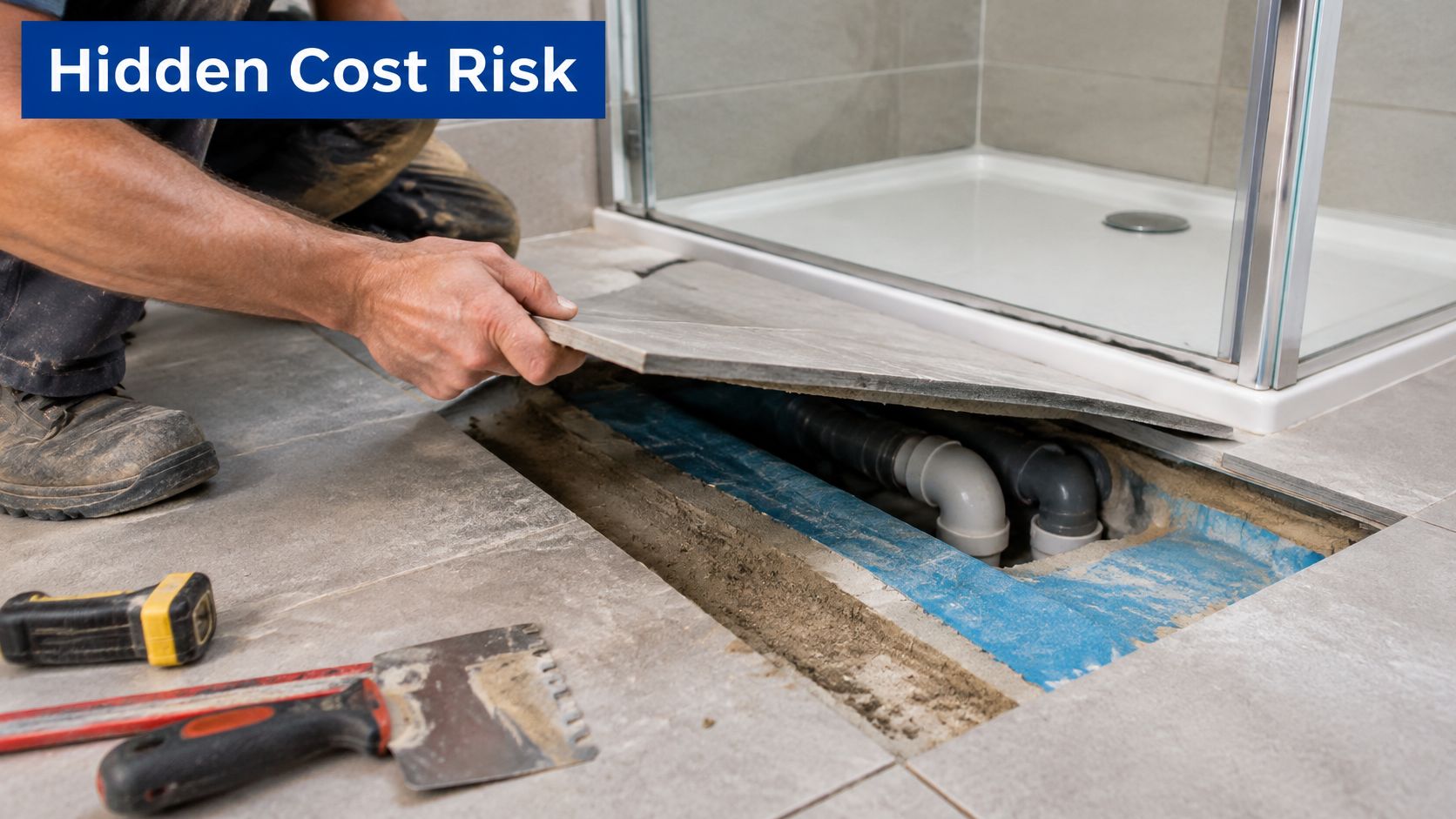
Why the inspection has to happen before tiling
Tiles hide the membrane permanently. Once they're laid, nobody can see whether the shower floor has the required fall, whether the junction at the wall has a bond breaker, or whether a screw from the shower screen frame has pierced the membrane.
A defect discovered after tiling means removing finished surfaces to diagnose and repair it, then waterproofing and retiling again. The saving from skipping a step is a few hundred dollars. The bill for finding out later runs to demolition of work you've already paid for. Reading through handy tips to plan and maintain your bathroom before demolition starts is far cheaper than learning the same lessons after the tiles come off.
Practical rule: saving a few hundred dollars on substrate preparation, penetration detailing or curing time buys a much larger remediation exposure. Nobody ever saved money by rushing the membrane.
Plumbing relocation feeds directly into this risk. Every moved drain and every new shower configuration adds penetrations and junctions that need sealing and detailing, so a layout change raises the waterproofing workload along with the plumbing bill. A hobless shower is the classic case: removing the hob takes away the barrier that used to keep water in, so the falls and the membrane termination have to do that work instead. More preparation, more careful detailing, a higher waterproofing line. That's the right money to spend.
This is also where a cheap quote reveals its real shape. Two quotes can carry similar totals while one prices a full membrane system with certified inspection and the other carries a single unexplained line. The second one reads fine until the room is open and the variations start. A Melbourne contract should name the waterproofing system, the substrate preparation, the wet-area zones, the required falls and the penetrations, and it should require a waterproofing certificate or equivalent compliance record before tiling starts. If a quote can't tell you which system it's using and who's certifying it, the price is fiction.
How to Compare Quotes Line by Line
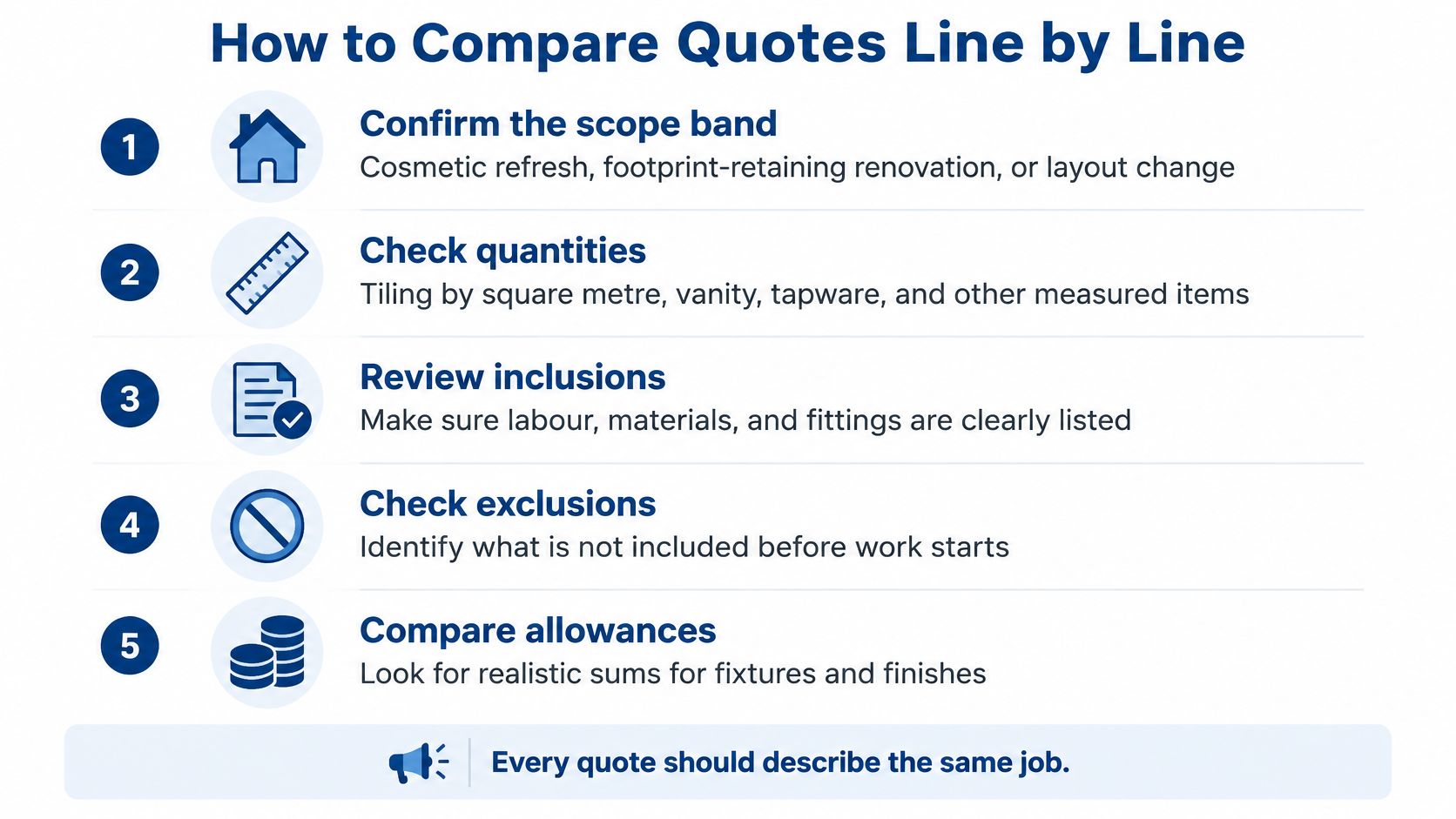
Broad national bands don't help you choose between three quotes. Canstar's bathroom renovation cost guide presents roughly $8,000 to $15,000 for basic work, $15,000 to $35,000 for standard renovations and $35,000-plus for premium projects, but it can't show which line items create the difference on your job. Labour is usually the largest single share of the total, with tiling, plumbing, waterproofing, electrical work and fixtures forming most of the balance, so a cheap headline can hide thin allowances rather than a better price.
Work through these eight checks with every contractor before you compare totals.
- Confirm the scope band. Cosmetic refresh, footprint-retaining renovation, or layout change. If two quotes sit in different bands, they price different jobs.
- Check quantities. Tiling by square metre, vanity size, tapware, toilet, shower screen and fixtures should each carry a stated quantity. A "tiling allowance" with no area is a placeholder waiting to become a variation.
- Check demolition, disposal and waste removal are itemised. These are the easiest lines to bury in a lump sum and the easiest to add later.
- Check plumbing relocation and electrical work sit on separate lines, with the licensed trades named. A single "plumbing" line hides whether anything is moving.
- Confirm the waterproofing system, substrate preparation, falls, floor wastes and penetrations, plus the certificate that must exist before tiling.
- Check ventilation and compliance documentation are included. Extraction and certificates are two of the most commonly excluded items.
- Confirm provisional sums, the variation process, GST treatment and defect coverage periods. Provisional sums are where a fixed price stops being fixed.
- Compare totals only after the inclusions match. Until then, you're comparing documents, not prices.
The trap in all eight is the same. A low allowance for preparation, waterproofing, ventilation or disposal doesn't disappear, it moves to the variations column after demolition, when you've already committed. Two quotes can both describe a "standard renovation" while one keeps every service in place and the other relocates the shower. The cheapest-looking quote is the lowest-cost project only if the exclusions match line for line.
A quick band check catches most mismatches. A quote near A$15,000 usually matches a small ensuite or a footprint-retaining refresh. One near A$25,000 matches a standard footprint-retaining job. One near A$35,000 usually signals a larger room, a layout change or premium finishes. If a quote doesn't fit its band, ask which inclusion explains the gap before you look at totals.
When a Cheaper Renovation Costs More Later
A cheaper renovation is only cheaper if nothing in it has to be undone. Two things get undone most often: waterproofing and accessibility.
Waterproofing is usually priced as a percentage or a flat allowance, and the basis matters more than the number. On a standard Melbourne bathroom the work typically runs A$800 to A$1,500, so a quote carrying a much lower allowance deserves a question, not a tick. Ask each contractor which basis they've used, a flat allowance, a percentage of the contract, or a rate per square metre, and check what sits inside that price. The lower figure usually means fewer penetrations detailed or thinner substrate preparation, not a better deal.
The accessibility question is the one generic cost tables skip. A bathroom that technically fits standard fixtures today can need expensive modification if mobility declines, if someone in the house is injured, or if the property is adapted for ageing in place. Retaining the layout is the cheapest decision today and not automatically the cheapest long-term one. The work that has to happen during the build is the work you can't retrofit cheaply, which our guide to the 5 mistakes to avoid when renovating your bathroom covers in detail.
Fix the things that live inside the wall while the wall is open. Everything else can wait.
Future-proofing versus rework cost
Some items must be completed during waterproofing or framing, because opening the wall again costs more than the item itself. Others can be staged without penalty.
Do it now, while the wall is open
- Reinforcing in the wall for future grab rails, added as noggins before sheeting
- A level-entry shower, which changes the falls and the membrane detailing anyway
- Preserved circulation space, decided at layout stage, not after the vanity arrives
- Lighting positions, because new cable runs are cheap before sheeting and expensive after tiling
Stage it later
- Grab rails and specialist fittings, screwed into reinforcement that's already there
- Shower seats and other mobility hardware, added when needed
- Accessory upgrades that don't touch the membrane
Moving plumbing purely for appearance is the opposite trade-off. Rerouting supply and waste lines adds pipework labour, pressure testing, waterproofing rework and patching for a visual gain only. Spend that money inside the wall and the floor, then let the finishes wait.
The decision question is blunt. Is a cheaper renovation cheaper if it makes later compliance, ageing or water-damage repair harder? When the answer is no, that saving isn't a saving.
Set Your Budget and Request Itemised Quotes
Build the budget in a fixed order, because doing it backwards is how projects blow out.
- Choose your target band from the scope table, not from a square-metre rate.
- Mark which cost drivers apply to your property: heritage overlay, moved plumbing, complex waterproofing, electrical upgrades, access constraints.
- Request itemised quotes from at least three contractors using the eight checks above, and insist each one states the same inclusions.
- Confirm the waterproofing certificate, warranty and defect coverage in writing before you sign anything.
Then add a contingency for what demolition reveals. Say a quote comes in at A$30,000. Holding back 10% to 15% on top of that, around A$3,000 to A$4,500, covers most of the substrate surprises that appear once the sheeting comes off. It's not pessimism, it's the predictable part of an unpredictable stage.
Compare totals only once inclusions match, and ask for the itemised format in writing. Elite Bathroom Renovations Melbourne provides an obligation-free quote after an on-site meeting, which is the right format for this: someone walks the room, looks at the subfloor and the board, and prices what is there.
The next action is simple. Book an on-site assessment, get the scope itemised line by line, and confirm every figure in writing before any deposit changes hands.
Elite Bathroom Renovations Melbourne handles the full sequence in-house, with tilers, plasterers, electricians, plumbers, painters and cabinetmakers working to Australian Standards and backed by 10-year waterproofing, 10-year structural and 2-year minor defect coverage. If you want a scope itemised line by line before you commit, Elite Bathroom Renovations Melbourne will walk your bathroom, price what's there and put the inclusions in writing.
