

Expect to pay somewhere between AUD 14,000 and AUD 42,000 for a complete bathroom renovation in Melbourne, with a mid-range project landing near AUD 23,000. Those numbers assume a full strip-out and rebuild by licensed trades, and where your job falls inside that band depends far more on what happens behind the tiles than on the size of the room.
The cost of bathroom renovations in Melbourne is a scope question wearing a price tag. Demand isn't the issue: the Housing Industry Association estimated demand for approximately 244,000 bathroom renovations across Australia in 2024 and 2025, as reported by news.com.au. With that volume of work going through the market, the difference between a fair quote and an expensive one is rarely the hourly rate. It's what each quote leaves out, and what comes back later as a variation once the room is open.
This guide prices the job the way an estimator does. Ranges first, then the trade items that produce them, then the inclusions that decide whether the cheapest headline number is the cheapest bathroom.
Table of Contents
- Bathroom Renovation Costs in Melbourne at a Glance
- Why Similar Bathrooms Cost Very Different Amounts
- How Labour Shapes the Bill for Melbourne Trades
- Tile and Material Prices Per Square Metre
- How Melbourne Compares With National Cost Figures
- Compare Quotes by Scope Before You Sign
Bathroom Renovation Costs in Melbourne at a Glance
For Melbourne homeowners, a complete bathroom renovation typically falls within an approximate AUD 14,000 to AUD 42,000 range, with a mid-range project around AUD 23,000, according to Melbourne bathroom benchmark pricing from Tilesmate. Treat both numbers as approximate bands for a full project, not as a quotation for your room.
The force behind those totals is coordinated trade work, not floor area. Demolition, plumbing relocation, electrical work, waterproofing, screeding, tiling, cabinetry, sanitaryware and final fit-off all have to be sequenced, and most of those trades attend whether the room is four square metres or nine. A larger room adds tile, paint and time. It doesn't add plumbers.
Melbourne bathroom renovation cost by project scope
| Project scope | Typical Melbourne total | Main price driver |
|---|---|---|
| Complete renovation, existing layout kept | From about AUD 14,000 | Like-for-like fixtures, no drainage changes |
| Mid-range complete renovation | About AUD 23,000 | Standard tiling, new vanity and shower screen |
| Complete renovation with plumbing relocation | Toward AUD 42,000 | Moved drainage, extra slab or wall work, complex waterproofing |
| Cosmetic refresh (vanity, tapware, lighting, paint) | No published Melbourne figure | Layout and tiles unchanged |
Reading the table without guessing
Each row describes a scope of work, not a room size. The bottom of the band belongs to projects that keep the toilet, shower and basin where they are, because a like-for-like replacement limits concealed pipework changes, wall and floor repair, and the chance of uncovering non-compliant or deteriorated substrate once the tiles come off.
The top of the band belongs to projects that move drainage. Relocating a waste pipe can trigger extra slab or wall work, longer plumbing hours and more complex waterproofing transitions at the new floor falls.
The cosmetic refresh row carries no published Melbourne figure because local price guides quote complete projects rather than piecemeal upgrades. Budget it from the item list instead, meaning vanity, tapware, lighting, mirror and paint, because the trades involved are different from a strip-out and the arithmetic doesn't scale down.
A single headline allowance tells you the contractor's total. A trade-separated quote tells you what happens when the floor is out of level or the waterproofing has failed, and who pays for it. Ask for demolition, plumbing, waterproofing, tiling, fixtures and contingency as separate lines, then read the four factors that move a project between rows: layout, trade hours, materials, and inclusions. The last one causes more disputes than the first three combined.
Why Similar Bathrooms Cost Very Different Amounts
Two bathrooms of identical dimensions can attract quotes at opposite ends of the band, and the lowest figure is rarely the cheapest project. The rooms match. The scope behind each number does not. A quote built on narrow inclusions and generous exclusions looks sharp on the tender page, then recovers the difference through variations once demolition starts.
Decisions that move a bathroom quote up or down
| Decision | Lower-cost choice | Higher-cost choice | Why the price moves |
|---|---|---|---|
| Drainage points | Toilet, shower and basin stay in place | Drains moved to new positions | Extra slab or wall work and plumbing labour |
| Waterproofing | Existing membrane tested and sound | Full renewal with new falls and sealed penetrations | Failed waterproofing forces tile and fixture removal later |
| Substrate | Walls and floor sound after demolition | Deteriorated or uneven surfaces found | Repair and preparation add hours across several trades |
| Fixtures | Like-for-like basin, toilet and shower | Upgraded fixtures and custom joinery | Higher supply cost plus extra fitting time |
Drainage position is the first and largest lever. Keeping the fixtures where they are holds plumbing work to connection, renewal and fit-off. Moving a drain opens the floor or wall, reroutes the waste and vent, and rebuilds the falls around a new outlet.
Waterproofing condition decides whether the room can be saved or has to be stripped. A membrane that has failed means tiles and fixtures come off before anything new goes on, and the rectification is priced at today's rates. A cheap quote often assumes the membrane is sound; a thorough one prices the renewal and lets you delete it if testing proves otherwise.
Substrate surprises appear only after demolition. Uneven floors, bowed studs, water-damaged sheeting or a decades-old leak add preparation hours across several trades, and no pre-demolition inspection can rule them out entirely. Headline quotes diverge most here: one contractor prices an allowance for repair, another excludes it and charges whatever the job reveals.
Fixture specification adds a supply cost and a fitting cost at the same time. A freestanding tub, a frameless screen or custom joinery all demand more handling and more careful setting out than a stock vanity and a pivot door.
Practical rule: hold a contingency sized to the age of the house, and release it only when the walls are closed and the waterproofing has been signed off.
Wide spreads between quotes are not a modern phenomenon. The Australian Bureau of Statistics reported that by 1999 almost 1 million Australian households had completed a bathroom upgrade during the previous decade, and in the year ending June 2001 Australians spent AUD 14.321 billion on alterations and additions to dwellings. Spending stretched from minor updates to full refits even then, which shows scope has always divided bathroom budgets far more than room size does.
A shower that moves to the opposite wall
Run the same room through two scopes. In the first, the shower stays put and the tiler re-sheets, waterproofs and retiles the existing recess. In the second, the shower moves to the opposite wall.
That single decision creates a new waste run under the floor, extends the supply lines, requires new screed falls to a different outlet, and builds waterproofing junctions where none existed. The tiling set-out changes around the new opening, the screen becomes a made-to-measure piece, and the electrician may need to reposition a light or an exhaust fan. The finish schedule hasn't changed. The labour has, across four trades.
Before you tender, you control the layout, the fixture specification and the tile format. After demolition, you control almost nothing except how well your contingency was sized, and whether the quote you signed priced the unknowns or merely postponed them.
How Labour Shapes the Bill for Melbourne Trades
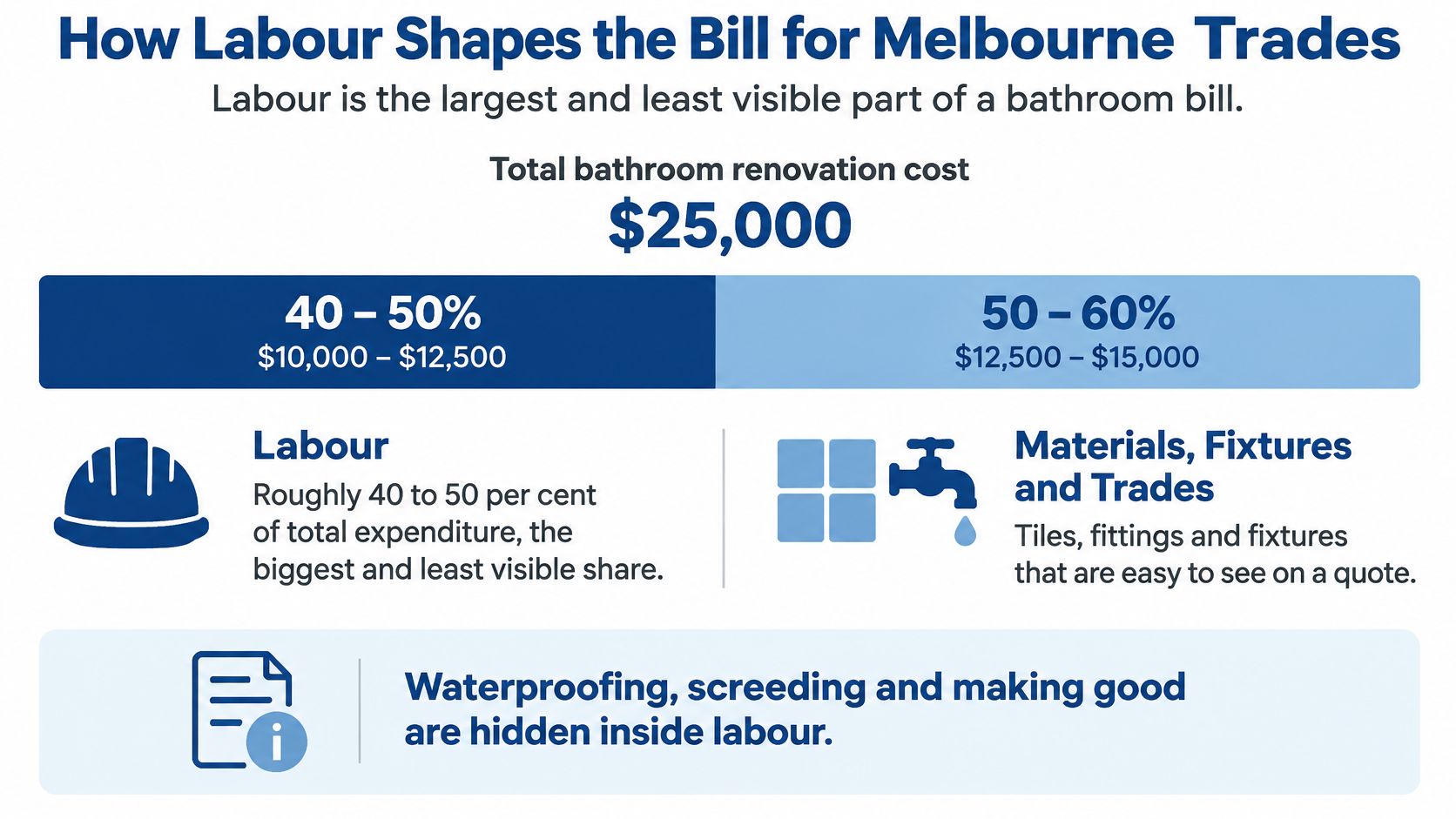
Labour is the biggest line in a bathroom budget and the least visible one on a quote. Industry-oriented Australian benchmarks commonly place labour at approximately 40% to 50% of total expenditure, meaning a AUD 25,000 renovation may allocate roughly AUD 10,000 to AUD 12,500 to trades before materials are counted, according to The Quote Yard's guide to finding a bathroom renovator in Melbourne.
The same guide reports Melbourne-specific average trade rates near AUD 68.80 per hour, above the indicative figures cited for Brisbane and Sydney. That rate matters most when a quote lists hours or allowances rather than a fixed price, because every added task converts into dollars at the top of the range.
Trade labour share at 40% and 50% of total cost
| Total renovation | Labour at 40% | Labour at 50% |
|---|---|---|
| AUD 14,000 | AUD 5,600 | AUD 7,000 |
| AUD 23,000 | AUD 9,200 | AUD 11,500 |
| AUD 25,000 | AUD 10,000 | AUD 12,500 |
| AUD 42,000 | AUD 16,800 | AUD 21,000 |
Why complexity costs more than finishes
Relocating plumbing, installing multiple tile formats, constructing niches, correcting uneven substrates and coordinating waterproofing inspections each add hours across plumbers, tilers, electricians and waterproofers. A premium tap adds one supply cost and a short fitting time. A second tile format can add days of cutting, dry-laying and grout-joint detailing.
Tiling is the most specification-sensitive trade in the room. Standard-format layouts set faster than intricate mosaics, large-format slabs or patterns with many cuts, and heavier products may need extra substrate preparation and handling before the first tile goes down.
Where the hours hide: waterproofing, screeding and making good never appear as a line on a glossy quote, yet they're the reason two bathrooms of the same size need different labour.
Waterproofing belongs in the technical budget, not the optional finish list. Inadequate falls, poorly sealed penetrations or incompatible junction detailing let water in, and the repair means removing tiles and fixtures to reach the membrane. That's the most expensive kind of saving available to a homeowner.
If you want to see how the trades stack in sequence, the order of waterproofing, screeding and tiling in a full bathroom renovation in Melbourne is worth understanding before you compare prices. Ask each tender for labour assumptions, hourly or fixed allowances, and the number of trade visits the price assumes. Two quotes with the same total but different visit counts aren't the same quote.
Tile and Material Prices Per Square Metre
Tile is the one line where taste and price meet on the same square metre. Get the format wrong and the material cost is the smaller half of the mistake.
Tile prices per square metre in Melbourne
| Tile type | Price per square metre (Melbourne) | Installation effect |
|---|---|---|
| Porcelain | AUD 35 to 140 | Standard formats install fastest |
| Natural stone | AUD 120 to 300 | Heavier; may need extra substrate preparation |
| Mosaic | AUD 150 to 400 | Extra alignment, cutting and grout-joint time |
What a square metre rate hides
Porcelain is the baseline and the fastest to set in standard formats. Natural stone carries more weight per box, which can mean additional substrate preparation and more careful handling on stairs and through tight hallways.
Mosaics are the trap for the unwary. Small sheets multiply alignment, cutting, grout-joint and detailing time, and the effect is strongest on shower floors, in niches and around pipe penetrations where every cut is a small, slow one.
The arithmetic on a 6 square metre floor
At AUD 35 to AUD 140 per square metre, porcelain for a 6 square metre floor costs AUD 210 to AUD 840 in tiles. The same area in mosaic, at AUD 150 to AUD 400, runs AUD 900 to AUD 2,400. Natural stone lands between them at roughly AUD 720 to AUD 1,800.
Those figures cover supply only. The gap widens once setting starts, because a mosaic shower floor takes longer to align, cut and grout, and the tiler charges for that time rather than for the tile. On a small floor, labour for mosaic can exceed the entire material difference.
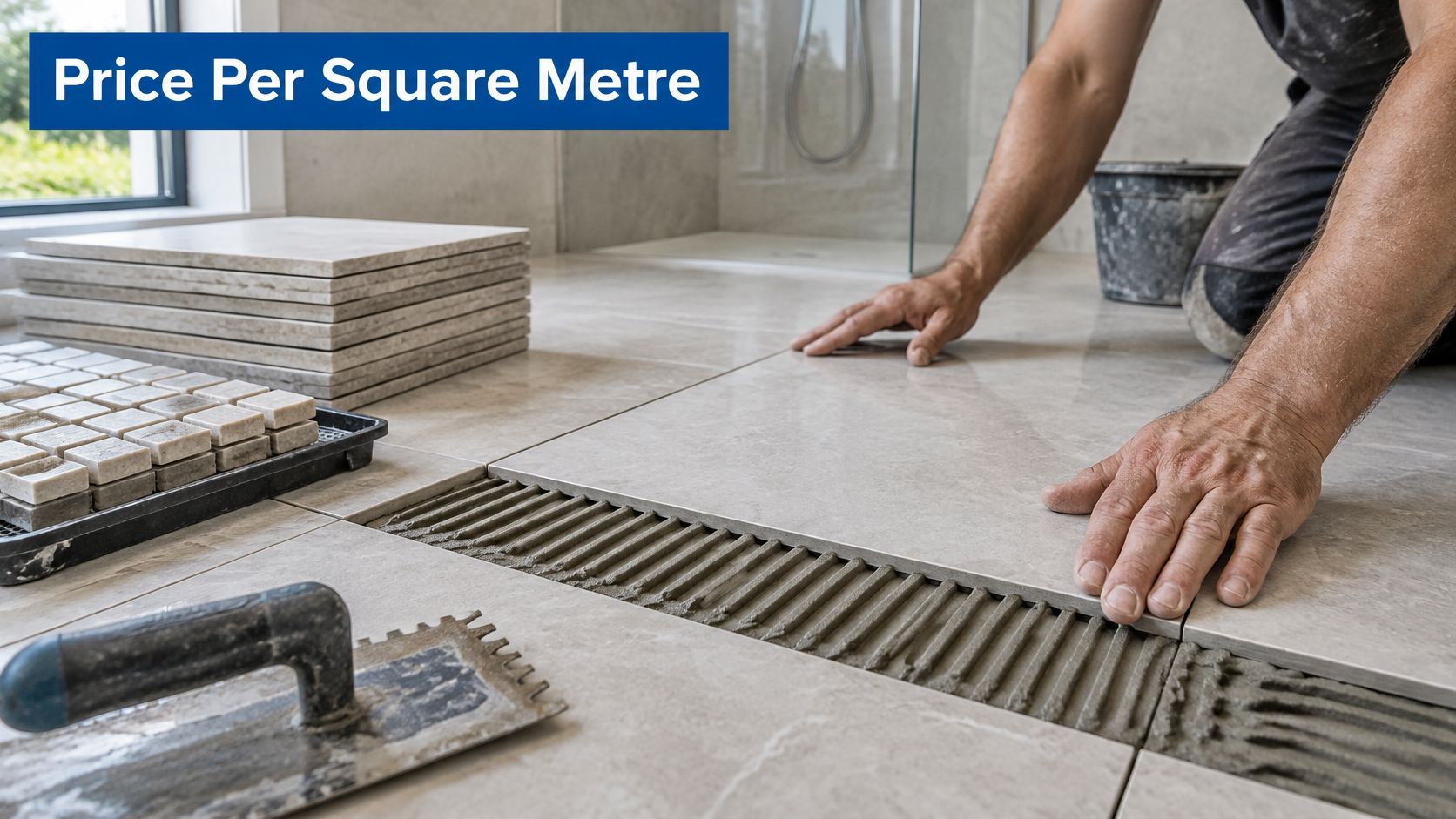
Laying tile to a consistent line and fall is the part of the job most homeowners underestimate.
Choose a format by how many cuts the room needs, not only by the price per square metre. A large slab in a narrow room generates waste and handling, while a small mosaic across a large floor generates grout lines and time. Read more on tiling works for bathroom renovations in Melbourne before you settle on a format. Then ask the tiler to state the lay pattern, the waste allowance and the adhesive system in the quote. If a quote names only a tile rate, the labour conversation hasn't happened yet.
How Melbourne Compares With National Cost Figures
National figures work as a sanity check on a local quote, provided you match them to the right scope. Budget Direct's 2024 Australian home renovation survey found that more than 30% of respondents allocated between AUD 5,000 and AUD 15,000 to renovation work and that bathrooms and kitchens were the two most popular areas to renovate, while Hipages data cited in the same research placed the cost of renovating a single room anywhere from AUD 2,000 to more than AUD 70,000.
That 30% band measures renovation spending across a whole house, not a bathroom alone, which is why it sits below a full Melbourne strip-out. The Hipages spread is the more instructive number, because it shows scope moving a single room across a 35-fold range.
The Housing Industry Association put a small ensuite renovation at AUD 10,000 to AUD 25,000 in 2025, including labour, trades and materials, as cited by Architecture & Design. An ensuite carries a shower, a basin and a toilet in a tight footprint, so it sits at the low end of the complete-renovation band even with new finishes.
Read against those figures, the midpoint of the Melbourne complete-renovation band, about AUD 28,000, lands halfway between AUD 14,000 and AUD 42,000 and well inside the Hipages single-room spread. A quote near that middle is usually pricing the scope the national figures describe: a full strip-out with standard fixtures, sitting between a cosmetic refresh and a structural rework.
When a quote sits outside the band
A quote well below the band deserves more scrutiny than one in the middle. Below the floor usually means work has been excluded, deferred or priced as an allowance that will be corrected later. Ask what the number assumes about demolition, waterproofing and disposal before you treat it as a saving.
A quote well above the band should arrive with a scope that justifies it: moved drainage, structural repair, heritage constraints or premium stone. If it doesn't, the difference is margin or contingency loaded into the total.
A gap in either direction is a reason to ask questions. Use these national bands as order-of-magnitude checks, never as quotes. A small ensuite and a full main bathroom aren't the same product, and a median is pulled upward by projects that moved walls and plumbing.
Compare Quotes by Scope Before You Sign
The cheapest headline number is often the most expensive job. Australian estimates for a standard renovation span roughly AUD 8,000 to AUD 35,000, while Melbourne advertised starting prices reach about AUD 19,999 to AUD 34,900, according to Renovabuild's review of Australian bathroom cost guides. The two ranges describe different work packages wearing similar labels, so the gap between them says nothing about which provider is cheaper.
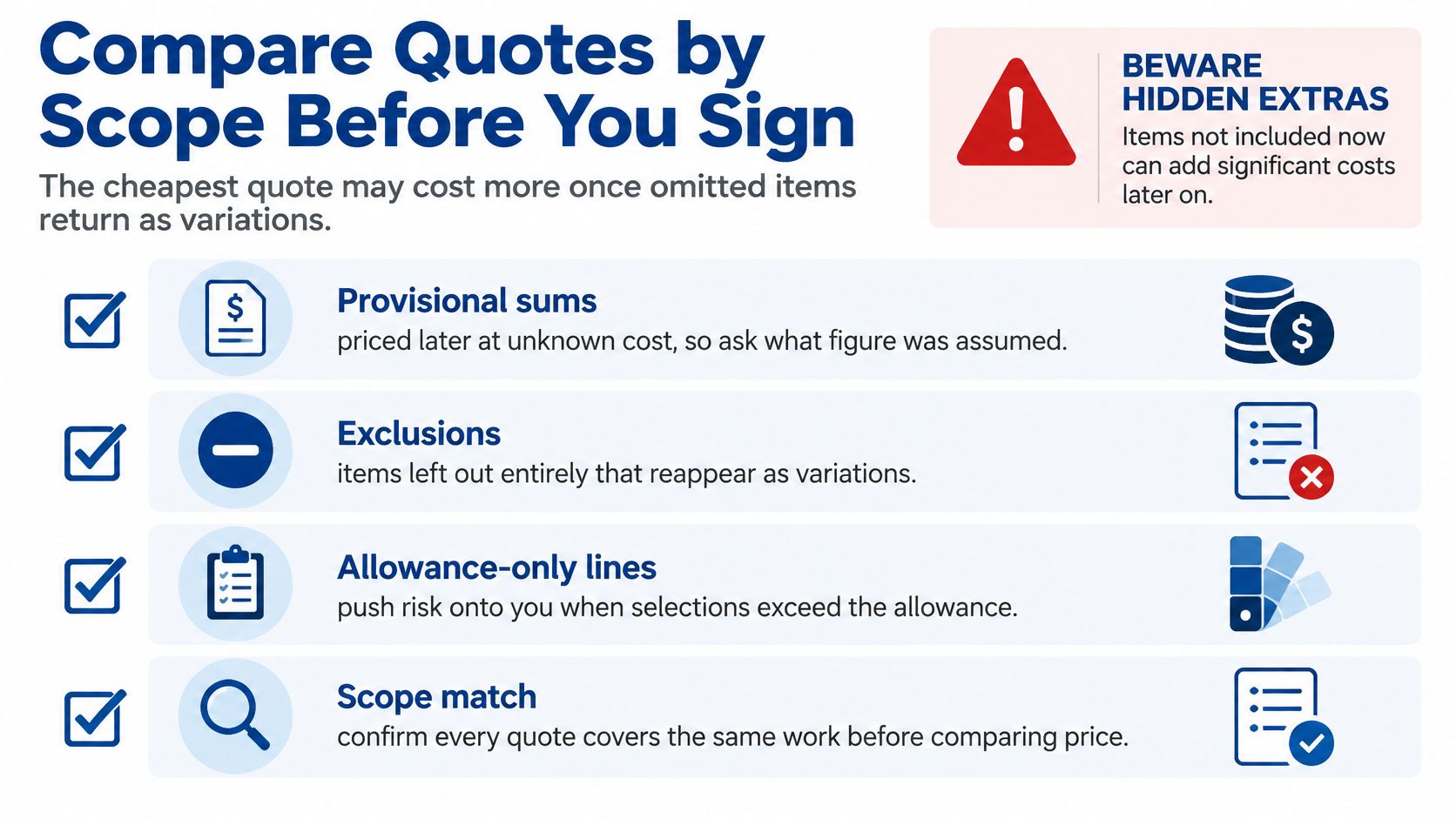
Three mechanisms shift cost from the quote into the invoice. A provisional sum prices an unknown item later, at whatever it costs when the work is done. An exclusion leaves work out entirely, so it returns as a variation. An allowance-only line sets a figure for tiles or fixtures that covers only the bottom of the range, and pushes the overrun onto you.
Each mechanism keeps the headline total low while the risk stays with you, and each one is visible on the paperwork before you sign. A provisional sum appears as a line marked provisional, with a figure that can move. An exclusion sits in the terms under what the price does not cover. An allowance-only line names a dollar amount for an item you have not chosen yet.
The inclusions checklist
- Demolition and disposal: a quote without a skip and a tip fee usually bills removal later, and old tiles and screed are heavy.
- Plumbing scope: if the quote doesn't say whether drainage moves, assume it stays put, and that the first relocated waste is a variation.
- Waterproofing renewal and warranty: a missing membrane line means the old one stays, or the new one goes in without cover.
- Tile supply and lay pattern: no stated pattern means the simplest set-out, with feature walls and niches priced separately.
- Fixture supply: confirm who buys the tapware, toilet and screen, because supply responsibility decides who chases a missing part.
- Electrical work and compliance: extra downlights, a heated towel rail or a fan upgrade need a licensed electrician and a line in the quote.
- Joinery: a vanity described only by width and finish usually means a stock cabinet rather than made-to-measure joinery.
- Permits: building or plumbing permits should be named, with the fee and who lodges the application.
- GST and variation rates: the rate charged for changes, and how it's calculated, belongs in the paperwork before work starts.
- Contingency: a visible allowance shows the builder expects surprises; an invisible one becomes a difficult conversation.
A worked comparison
Say one quote arrives at AUD 19,000 with no waterproofing renewal, and a second at AUD 23,000 that includes a new membrane, new screed falls and sealed penetrations. The first looks AUD 4,000 cheaper until the old membrane fails under the new tiles.
Waterproofing is the clearest case because a failed membrane can only be reached by demolishing the floor above it. The rectification involves removing the new floor, replacing sheeting, re-waterproofing and retiling. The cheaper quote becomes the more expensive job, and the homeowner has already paid for the tiles twice.
The sequence that keeps you in control
- Write down the room's must-haves before you speak to anyone, so upgrades are choices rather than suggestions.
- Decide which layout changes justify the premium and hold the rest, and read the common mistakes to avoid when renovating a bathroom before you commit to a new floor plan.
- Set a contingency for concealed damage before you choose finishes, while it can still shape where you spend.
- Collect at least three itemised, trade-separated quotes and compare inclusions line by line before totals.
- Match any warranty offered against the waterproofing scope written in the quote, because one without the other is a promise with no mechanism.
- Ask each provider for licence, bonding and insurance details in writing, plus confirmation that the work follows the applicable Australian Standards.
Elite Bathroom Renovations Melbourne can be one provider in that comparison. Their stated coverage runs to 10 years on waterproofing and structure with 2 years on minor defects, which gives you a written warranty scope to test against step five.
Ask every provider the same three questions. What is included? What is excluded? What could change the price before the room is finished?
The answers tell you more than the total at the bottom of the page. A quote that names its exclusions is a quote you can price properly, and often the one that ends up costing least.
Ask Elite Bathroom Renovations Melbourne for a written quote, then set it next to the other responses and compare scope line by line before you compare totals.
