

Yes: reverse osmosis softens water by removing calcium and magnesium, the minerals that cause hardness, with Australian guidance describing approximately 90% lower dissolved-ion concentrations. It doesn't work like a salt softener, which swaps hardness minerals for sodium rather than removing a broad range of dissolved salts.
If both systems can reduce hardness, why wouldn't an under-sink reverse osmosis unit protect your shower as well as your kettle? The treatment point matters just as much as the treatment technology. For Melbourne homeowners, the sensible choice starts with identifying the symptom, testing the water and deciding which outlets need treatment.
Table of Contents
- Yes, Reverse Osmosis Removes the Minerals That Cause Hardness
- How a Membrane Removes Hardness
- How RO Compares With a Salt-Based Softener
- How to Test Feed and Permeate Hardness
- Where RO Helps, Where It Falls Short, and Common Myths
- Matching Your Water Problem to the Right Treatment
Yes, Reverse Osmosis Removes the Minerals That Cause Hardness
Yes, reverse osmosis removes dissolved calcium and magnesium salts, so it reduces water hardness. The important distinction is that hardness reduction describes a result, not a particular type of equipment.
Hardness is normally reported as milligrams per litre expressed as calcium carbonate, written as mg/L as CaCO₃. This gives laboratories a common basis for reporting the combined hardness contribution of different minerals. It doesn't mean the water contains visible particles of calcium carbonate.
What your hardness result means
The Australian Drinking Water Guidelines describe the hardness bands below, report approximately 5 to 380 mg/L as CaCO₃ across major Australian reticulated supplies, and recommend that hardness generally not exceed 200 mg/L to minimise scale in hot-water systems.
Water hardness bands and what they mean at home
| Hardness (mg/L as CaCO₃) | Classification | What it means at home |
|---|---|---|
| Below 60 | Soft | Low hardness-related scale risk on fittings and appliances |
| 60 to 200 | Generally good quality | Generally acceptable; staying below the upper end helps limit hot-water scale |
| 200 to 500 | Increasingly prone to scaling | Greater likelihood of scale on showerheads, taps and kettles |
| Above 500 | Severely scale-forming | Heavy scale potential; investigate suitable treatment |
Classification labels aren't universal. Some Australian guidance uses different boundaries for soft, moderately hard, hard and very hard water, so check the classification printed on your laboratory report before comparing labels.
A hardness band helps you assess scale potential, but it isn't a complete drinking-water safety assessment. Nor does a national supply range establish what comes out of your Melbourne kitchen tap.
Start with the water you actually receive
Ask your water supplier for the hardness figure relevant to your supply area. If you're planning treatment, particularly for persistent deposits or a renovation, test a sample from your own property as well.
Consider where deposits appear. A crusty kettle and repeated deposits across shower fittings call for different installation decisions, even when the underlying minerals are the same.
Practical rule: Don't buy a whole-house treatment system simply because a kettle needs descaling. Establish the hardness level and the extent of the problem first.
RO can produce water with very little mineral content. That can be useful, but the lowest possible hardness reading isn't automatically the best target for every plumbing installation.
How a Membrane Removes Hardness
Think of an RO membrane as a selective door attendant: water can pass through, while many dissolved salts are turned back. It's a useful analogy, although the membrane does more than mechanically sieve out large particles. Its material and separation properties allow it to reject dissolved ions that an ordinary sediment filter won't capture.
Calcium and magnesium can remain dissolved in clear-looking water. Heating or evaporation can encourage scale-forming compounds to precipitate, leaving deposits inside a kettle or around a drying tap.
The membrane stage separates the incoming water into treated water and a concentrated reject stream.
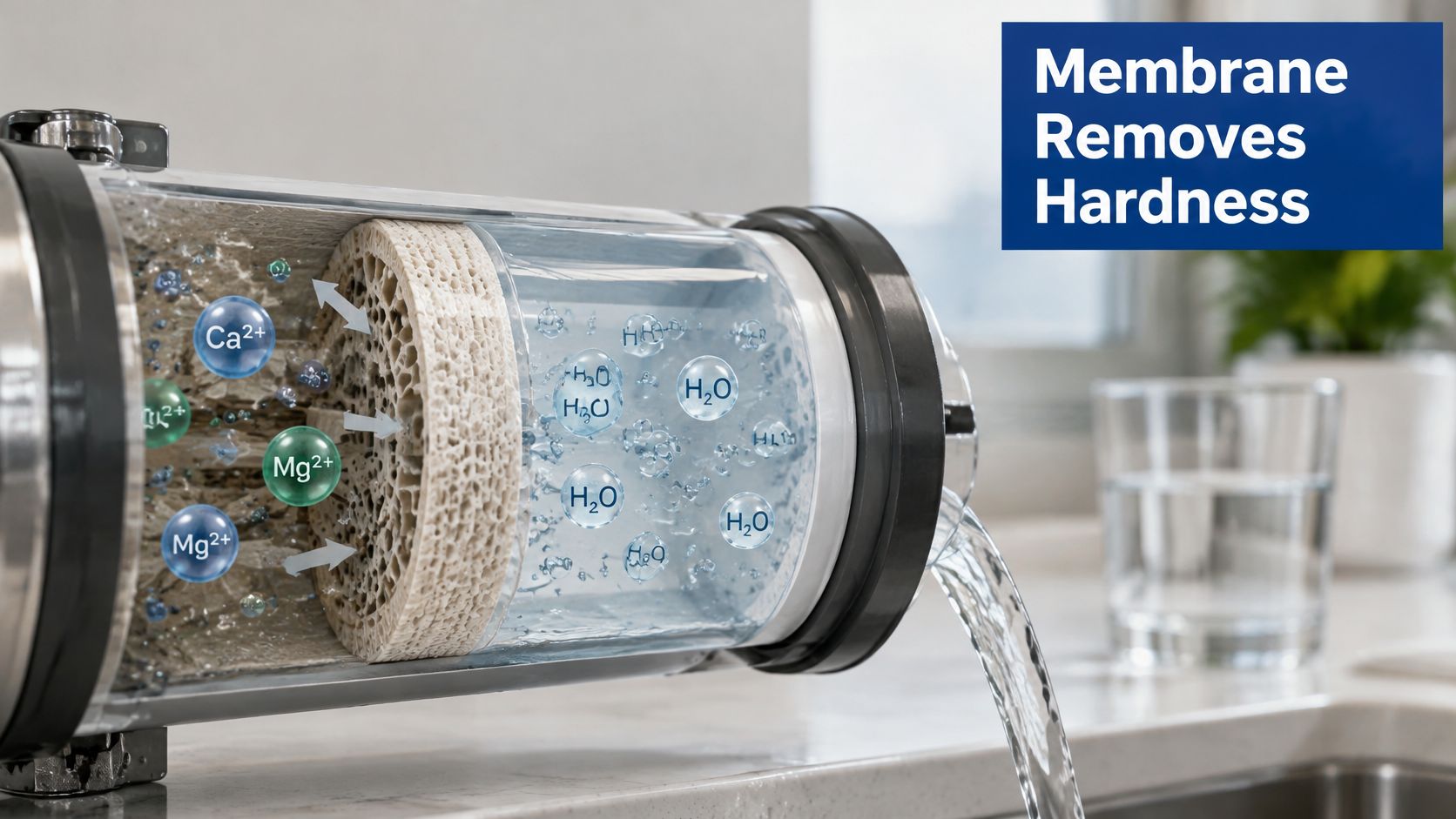
Follow the water through the system
- Feed water arrives under pressure. Pretreated incoming water moves across the semipermeable membrane.
- Permeate passes through. This is the treated water delivered to the drinking-water outlet, sometimes through a storage tank.
- Rejected salts leave separately. A concentrated stream carries them away to the drain rather than allowing them to accumulate indefinitely at the membrane.
Australian water-quality guidance on treatment processes describes RO as reducing dissolved-ion concentrations by approximately 90%, and uses alternative hardness classifications of below 75 mg/L as soft, 75–150 mg/L as moderately hard, 150–300 mg/L as hard and above 300 mg/L as very hard.
That broad ion-reduction figure explains why hardness can fall sharply. It isn't a guarantee that every installed unit achieves the same calcium or magnesium removal under all conditions.
Why performance changes
A membrane needs suitable operating conditions. Feed pressure, water temperature, membrane condition and pretreatment all influence the result you get at the tap.
Sediment can foul the system, while chlorine can damage susceptible membranes. Maintain the sediment and carbon cartridges rather than treating them as optional accessories.
Say your kettle receives only water from the RO outlet. Reduced mineral input should mean less new hardness scale, but existing deposits still need cleaning, and water from an untreated mixer outlet won't have the same characteristics.
A change in taste or flow can prompt an inspection. Neither tells you precisely how much hardness remains, which is why paired water tests are more useful than appearances alone.
How RO Compares With a Salt-Based Softener
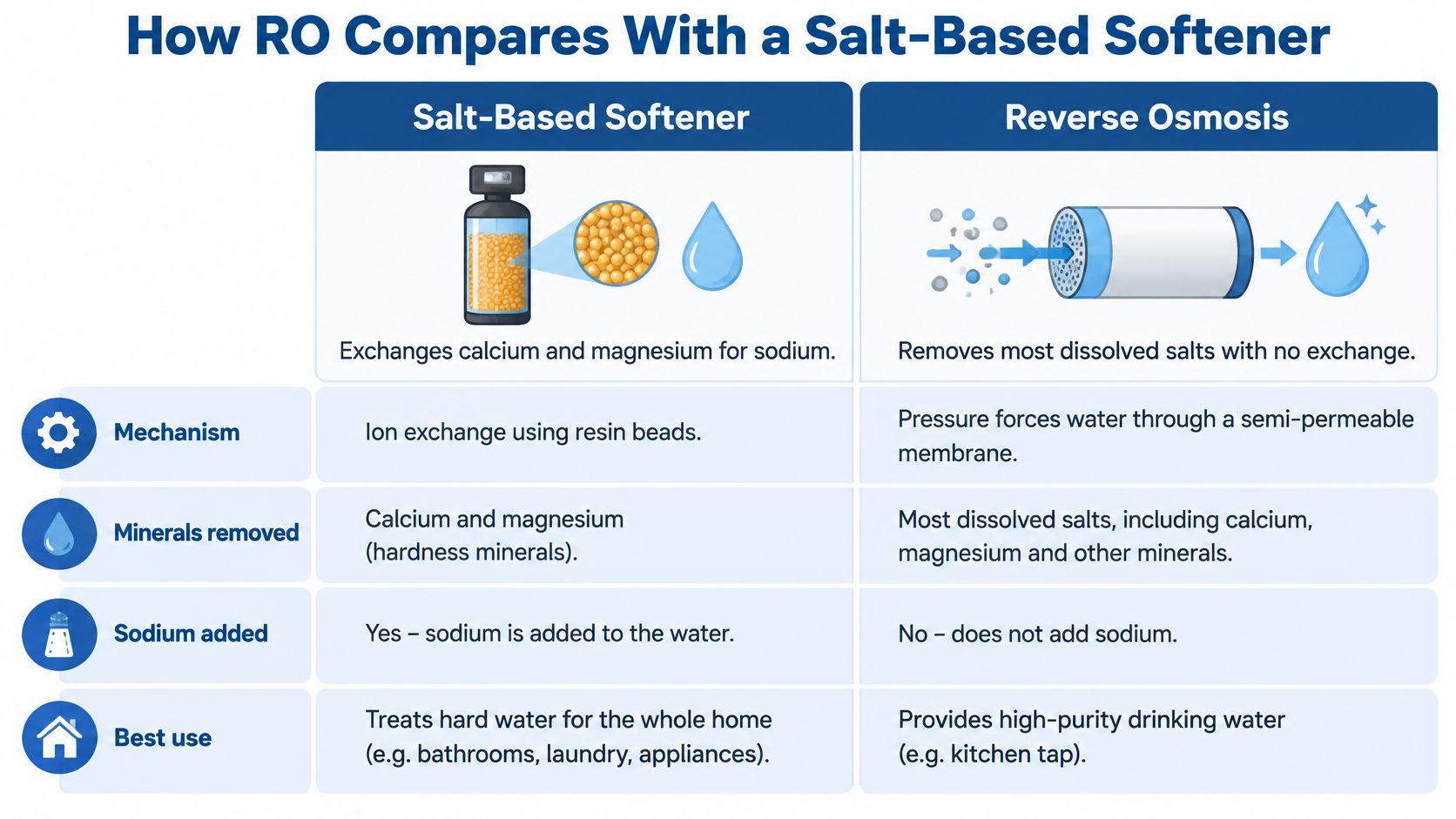
A salt-based softener exchanges calcium and magnesium for sodium; RO separates many dissolved salts from water. Neither process is automatically the better choice. They suit different treatment goals and plumbing arrangements.
Reverse osmosis versus a salt-based softener
| Feature | Reverse osmosis | Salt-based softener |
|---|---|---|
| How it works | Forces water through a membrane that rejects many dissolved salts | Exchanges calcium and magnesium ions for sodium on resin beads |
| Calcium and magnesium | Largely removed | Removed from the water and replaced with sodium |
| Sodium added to water | No sodium exchange | Yes, in exchange for hardness |
| Typical installation point | Under-sink or point-of-use; whole-house designs require larger equipment | Commonly on the incoming supply for whole-house treatment |
| Water wasted | Concentrated reject stream to drain; ratio is model-specific | Brine rinse to drain during regeneration; amount is model-specific |
| Suitability for drinking | Intended for drinking and cooking when appropriately selected and maintained; mineral content can be very low | Sodium addition needs consideration, particularly for people following a prescribed low-sodium diet |
| Maintenance | Sediment and carbon cartridge changes, membrane checks and replacement | Salt replenishment, regeneration checks and periodic resin assessment |
| Best fit | Low-mineral drinking and cooking water at a designated outlet | Hardness-scale protection for hot water, showers and other connected fixtures |
The visual comparison highlights the difference between exchanging ions and separating dissolved salts.
Coverage matters more than the label
A correctly sized softener installed upstream of household branches can treat the water supplied to many fixtures. The installer still needs to confirm which branches are connected, whether any outlets should bypass treatment and how regeneration drainage will work.
An under-sink RO unit has a much narrower job. Its output must suit drinking-water demand, available pressure, storage arrangements and the space inside the cabinet.
Whole-house RO is possible, but it isn't a kitchen unit fitted beside the water meter. It requires a larger design that addresses peak demand, storage, wastewater and the chemistry of the treated water.
Drinking water and maintenance need separate decisions
Don't assume softened water is unsuitable for everyone to drink. Equally, don't ignore sodium addition if someone has been advised to restrict sodium intake. Ask for advice based on the actual feed hardness, treated-water composition and that person's dietary requirements.
RO also isn't a maintenance-free route to better water. Access matters: cartridges that are awkward to reach are more likely to be neglected, and a concealed drain connection still needs proper installation.
Choose equipment for the water you need to treat, not for the strongest-sounding filtration claim.
If your main concern is widespread hardness scale, investigate whole-house softening. If your priority is low-mineral drinking and cooking water, assess point-of-use RO. Where both needs exist, a combined arrangement may make sense after testing.
For another explanation of the equipment distinction, this video provides a visual companion.
How to Test Feed and Permeate Hardness
Test the incoming water and the treated water using the same method and units. Taste can change without a corresponding change in hardness, and visible scale reflects accumulated deposits rather than today's membrane performance.
Use an accredited laboratory or a calibrated hardness test kit suitable for the expected measurement range. A drop-titration hardness kit is more useful for this task than a conductivity pen alone, because conductivity measures a broader property of the water.
Collect comparable samples
Check the supplier's information. Record the published hardness for your supply area as background, not as a substitute for a property-level result.
Sample the feed water. Choose a cold-water outlet upstream of treatment. If a whole-house softener is already installed, identify whether you're sampling raw supply water or softened water feeding the RO unit.
Sample the permeate. Collect from the treated outlet under normal operating conditions. Follow the laboratory's collection instructions or the test kit procedure, including any flushing requirements.
Record the units and sample point. Keep both results as mg/L as CaCO₃. Label any sample collected after a remineralisation cartridge, because its hardness may differ from raw membrane permeate.
Compare the actual readings. Check the laboratory's classification system before interpreting labels such as soft or moderately hard. Matching units matter more than matching descriptive words.
Interpret the change carefully
You can calculate hardness reduction by subtracting permeate hardness from feed hardness, dividing that difference by feed hardness and expressing the result as a percentage. This calculation isn't useful when the incoming result is zero or too close to the test method's detection limit.
A substantial reduction supports the conclusion that the unit is removing hardness. A smaller-than-expected reduction calls for investigation, not an immediate assumption that the membrane has failed.
Check pressure, cartridge condition, membrane seating, bypass arrangements and any post-treatment stage. If the feed water is already very soft, a simple home kit might not resolve the difference accurately enough.
Keep a service record: Save the paired test results alongside cartridge-change dates, membrane details and any pressure adjustments.
Repeat testing under comparable conditions. Consistent records help a technician distinguish gradual deterioration from a change in incoming water or a sampling mistake.
Where RO Helps, Where It Falls Short, and Common Myths
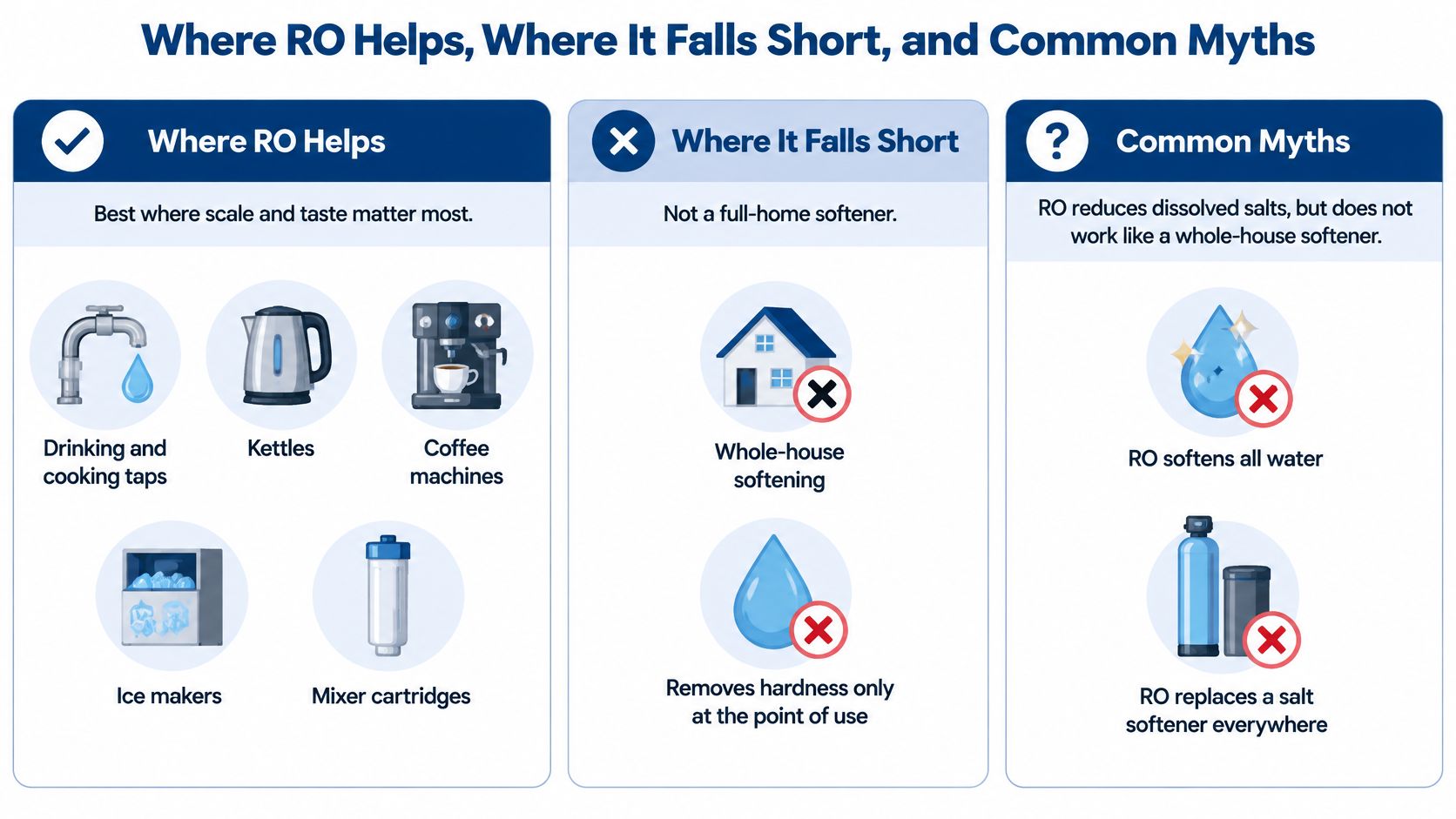
Does reverse osmosis make sense for every tap in your home? It can produce low-mineral water for a specific use, but the benefit depends on where that water goes. An under-sink unit, for example, treats its connected outlet, not the whole property.
Strong uses and practical limits
- Drinking and cooking taps: A dedicated outlet lets you use treated water for beverages and food preparation.
- Kettles and coffee equipment: Filling these from the treated supply reduces the hardness minerals entering them. Existing scale still needs to be removed.
- Ice makers and connected fittings: These can use RO water when they are connected to a suitably sized treated-water supply.
RO has limits, too:
- Whole-property demand: Treating showers, toilets and basins requires more production capacity and creates more reject water than treating drinking water alone.
- Broad mineral removal: RO removes useful minerals along with other dissolved salts. Remineralisation may be used to adjust taste and water chemistry.
- Plumbing compatibility: Very low-mineral water may need stabilisation before distribution through a property.
Common myths worth correcting
- RO and softeners do the same job: RO reduces a broad range of dissolved salts. A conventional softener targets hardness minerals through ion exchange.
- Softer is always better for plumbing: Water with very low mineral content may need adjustments for stability, rather than further mineral removal.
- An under-sink unit replaces whole-house treatment: It serves only its connected outlets. Shower and hot-water branches elsewhere remain untreated.
- A zero TDS reading proves perfect water: A TDS meter does not establish microbiological safety or reliably assess sediment and chlorine.
RO removes dissolved salts through a membrane. Some systems then add minerals back to adjust the finished water. The Victorian Government's desalination overview describes salt removal followed by remineralisation, illustrating why membrane-treated water may not be distributed unchanged.
Remineralisation does not mean the RO process failed. It adjusts the final water for its intended use, including taste and compatibility with downstream materials.
Ask for commissioning records
A useful handover should document feed hardness, permeate hardness, TDS or conductivity, operating pressure, recovery ratio and cartridge-change intervals. Recovery ratio describes how much incoming water becomes treated water rather than reject water.
Ask the installer to identify the sampling points and explain whether the final outlet includes remineralisation. Keep the operating manual and replacement cartridge specifications accessible.
A manufacturer's nominal removal claim can help compare products, but measurements from the installed system show how it performs with your water. Make sure the results cover the water at your point of use.
Matching Your Water Problem to the Right Treatment
The right system depends on which outlets and appliances need help. Test hardness first, then match the treatment to the symptom. White deposits can come from mineral scale, but appearance alone may not identify the cause.
Water problems, likely causes and suitable treatments
| Symptom | Likely cause | Does RO solve it? | Better first option |
|---|---|---|---|
| Scale on kettle or coffee machine | Calcium and magnesium deposits | Yes, if the appliance is filled with water from a point-of-use RO tap | Point-of-use RO, plus appropriate descaling |
| Scale on showerheads and glass | Hardness in the supply serving those fixtures | A kitchen unit won't treat shower water | Assess whole-house softening or suitable conditioning |
| Chlorine taste or smell | Disinfectant in the supply | Carbon pretreatment in an RO system can address it | Activated carbon filtration if chlorine is the only concern |
| Sediment or rust in water | Suspended particles, potentially from pipes | The membrane should not be the first particle barrier | Investigate the source and install suitable sediment pretreatment |
| Deposits in the hot-water system | Carbonate scale associated with hardness | Only if the treatment serves the heater's incoming supply | Upstream hardness treatment and hot-water servicing |
Choose the simplest treatment that fits
A chlorine taste does not automatically call for RO. Activated carbon may address that concern, while a sediment filter can trap suspended particles. Neither removes dissolved calcium and magnesium just because the water looks clearer.
Ask what a proposed water conditioner changes, whether it lowers measured hardness, and how its scale-control performance will be assessed.
For a bathroom renovation, plan treatment locations before finalising plumbing and cabinetry. Discuss plumbing works for a Melbourne bathroom renovation early, including service access, pipe routing and drainage.
Put the decision into practice
Choose point-of-use RO for lower-mineral drinking and cooking water. If confirmed hardness affects showers, glass and hot-water equipment, assess a whole-house softener. Both may suit a home with both needs, but a kitchen RO unit does not soften water throughout the house.
Before choosing equipment:
- Test hardness in comparable feed and treated-water samples where applicable.
- Identify the priority symptom and the outlets or appliances affected.
- Check feed pressure, wastewater routing and servicing space.
- Ask a licensed plumber to confirm the treatment point, connections and drainage.
Does reverse osmosis soften water? Yes, by removing dissolved salts, including hardness minerals. Whether it is the right purchase depends on where you need that treated water. Order a hardness test before buying a system.
Elite Bathroom Renovations Melbourne offers bathroom renovation planning and coordinated trades, including plumbers who can help assess how water treatment fits your bathroom layout. Bring your hardness results and a list of affected fixtures to the planning discussion, then visit Elite Bathroom Renovations Melbourne to discuss plumbing access, drainage and your renovation requirements.

Pingback: Reverse Osmosis Membrane Types Explained Simply
Pingback: RO Membrane Cartridge: Compatibility and Replacement
Pingback: Chilled Water System Design: Key Choices Explained