
The kettle has a pale ring of scale inside it, the tap water tastes flat and faintly chalky, and you've decided to deal with it. Perhaps there's already a housing screwed to the inside of the sink cabinet, or perhaps you're standing in a shop holding a cartridge and reading the box, trying to work out whether it matches your water rather than your cabinetry.
Most buying advice answers the wrong question. It compares housing sizes, gallon-per-day ratings and micron numbers, when the decisions that matter happen in two places. The first is before you buy, where compatibility is a test of your source water, your dynamic pressure and your water temperature, not a lookup of dimensions. The second is at commissioning, where a rejection percentage you write on a label inside the cabinet replaces the calendar as the thing that tells you when the membrane is finished.
The two are connected. Get the compatibility test right and the membrane spends its life inside its design envelope, which means the rejection figure you record on day one keeps its meaning for years.
Table of Contents
- What an RO Membrane Cartridge Does in Your Water Line
- When an RO Cartridge Is Not the Right Fix
- Compatibility Values to Check Before You Buy
- How to Confirm Compatibility Before You Buy
- Diagnosing Low Flow, Taste and Rejection Problems
- Deciding When to Replace Your Cartridge
What an RO Membrane Cartridge Does in Your Water Line
Water that tastes flat and slightly dry is usually telling you about what's dissolved in it, not about anything harmful. The complaint is aesthetic, and it comes from mineral salts plus the chlorine residual a utility leaves in the pipes to keep the network safe. Fixing that taste means taking a share of the dissolved content out, and that's the job the membrane gets handed.
Inside the cartridge, a semipermeable membrane is wrapped around a support layer and your mains pressure does the pushing. Picture a sheet of plastic turned into an extremely fine sieve. Water molecules are small enough to squeeze through. Most dissolved salts, and a long list of other contaminants, are not, so they stay on the feed side and get carried away in a stream that runs to the drain. Nothing is boiled off. It's a physical separation driven by pressure.
Three Flows You Can See Under the Sink
- Feed water arrives from the mains or the pump and carries everything dissolved in it, salts included.
- Permeate is the product water that reaches the tap, having passed through the membrane.
- Reject water, sometimes called concentrate or brine, leaves with the salts the membrane held back and goes to the drain.
Here is that mechanism drawn out end to end, from the tap to the sieve:
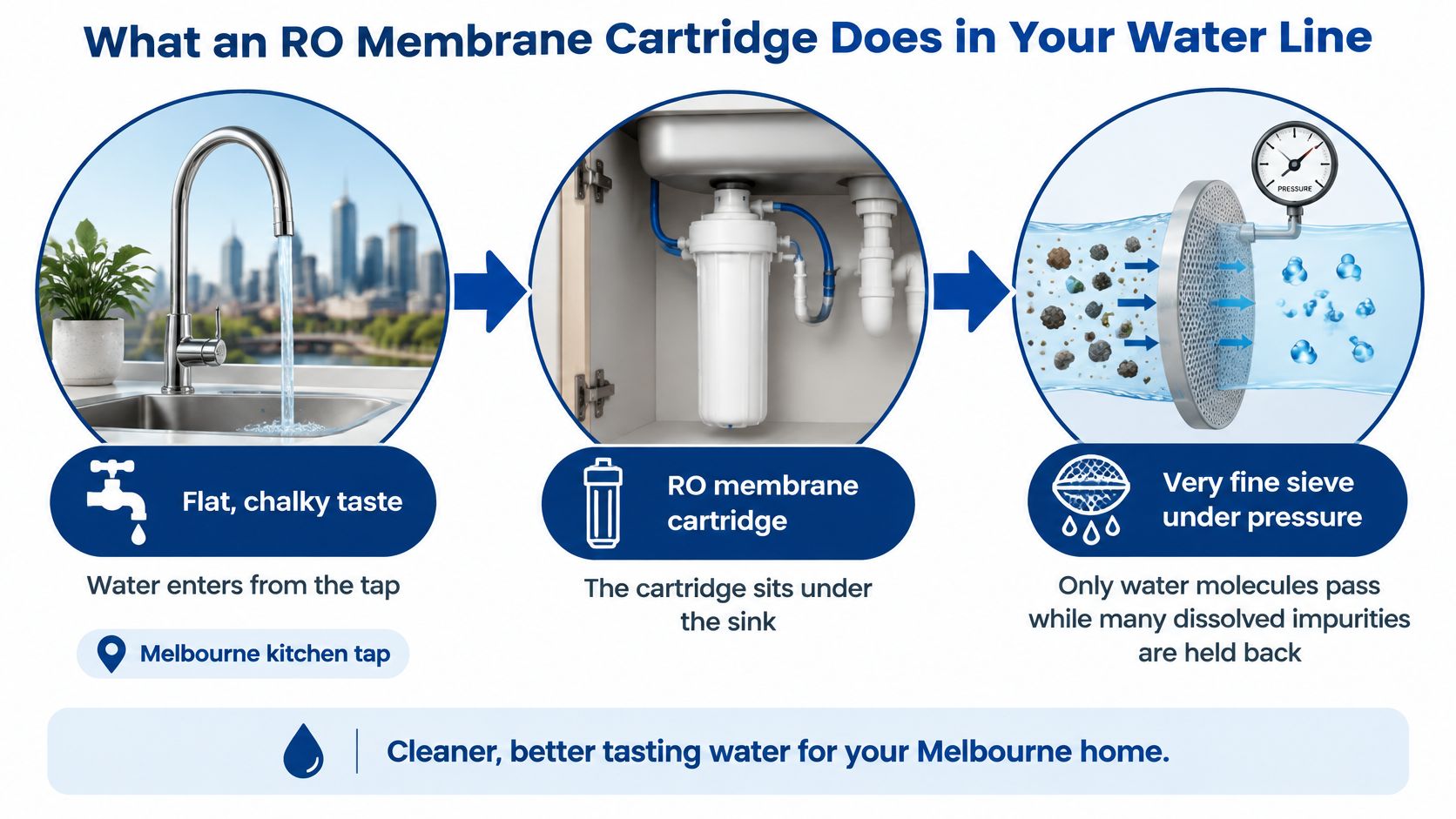
How much salt comes out? South Australian Health guidance covering RO and bore supplies puts reverse osmosis at roughly 95 to 99 per cent removal of total dissolved salts. Treat that as a range set by conditions, not a guarantee, because low pressure and cold water both pull the figure down.
The same principle runs at city scale. The Victorian Government's desalination history records that Perth's first modern large-scale seawater plant was completed in November 2006 and was the first major facility to supply desalinated water to an Australian capital city, at a reported capacity of about 45 billion litres a year, or roughly 130 million litres a day. Municipal plants run banks of membrane elements with monitored pressure, cleaning cycles and scheduled replacement. Your cartridge is the same idea at a kitchen's scale, and it fails for the same reasons when pressure, pretreatment or cleaning are neglected.
What the membrane won't do on its own is worth saying plainly. It isn't a sediment filter, so grit and rust wear it out. It isn't a carbon block, so chlorine attacks it. If taste or flow changes, the membrane is one of three suspects, alongside a loaded prefilter and sagging supply pressure.
When an RO Cartridge Is Not the Right Fix
Start with the verdict, because it changes everything you read afterwards. For most Melbourne households on a reticulated supply, an RO cartridge is a taste and preference upgrade, not a safety device. If your water meets the Australian Drinking Water Guidelines, it is already safe to drink.
The NHMRC's PFAS questions and answers says exactly that: Australian drinking water is safe when it meets the Australian Drinking Water Guidelines, and PFAS measurements from Australian water utilities have generally been below, or well below, current guideline values. The same guidance names reverse osmosis and other high-pressure membranes as one possible treatment for persistent chemicals, then adds the qualifier that matters. Treatment should be chosen for the specific contaminant and confirmed by verified system performance, not by the presence of a membrane in the box.
Recent PFAS treatment installations in Australia commonly pair activated carbon with ion exchange, which tells you where RO sits: as part of a multi-barrier strategy, not a universal first move.
Three Sources, Three Different Answers
Municipal supply with a chlorine complaint. The taste you're objecting to is disinfectant residual, and a carbon block removes it. Adding a membrane to that job is extra plumbing, extra reject water and extra maintenance for a benefit you may not taste.
Rainwater tank feeding the kitchen. Tank water carries sediment, roof grit and biofilm. Anything you fit downstream needs prefiltration first, because a membrane asked to handle raw tank water blinds itself with particulate matter within months.
Bore water with high total dissolved solids. Here a membrane earns its place, but only after someone has analysed the water. NSW Government guidance recommends laboratory testing of bore water for total dissolved solids and individual salts, because some constituents scale or damage the membrane unless specific pretreatment is designed in.
Note what lower total dissolved solids does not mean. Water with fewer dissolved minerals is not automatically healthier, and it is not sterile. If you're weighing up what a membrane changes about hard water, whether reverse osmosis softens water covers that distinction properly.
So answer three questions in this order before you spend anything:
- What is the source? Municipal, rainwater tank or bore.
- What is the specific contaminant or complaint? Chlorine taste, sediment, hardness, a documented chemical result.
- Does the certified claim on the product record cover that contaminant? If it doesn't name it, it doesn't cover it.
Watch a system being assembled before you commit to one, because the plumbing detail is where domestic installations go wrong:
The answers change for each reader type. An under-sink unit in a Melbourne kitchen lives or dies on question two, since a carbon filter may solve a taste complaint for a fraction of the cost. A caravan or RV adds a constraint no mains home has, because tank capacity and pump pressure decide whether the membrane produces anything useful at all. A commercial drinking-water unit serving an office or shop counter has to answer all three, then add duty cycle and storage to the design. If you're scaling treatment past a single tap, the planning logic in this guide to whole-house water filters in Australia covers the rest of the chain.
Compatibility Values to Check Before You Buy
Here are the numbers to hold against your own supply, your own tap and your own cabinet before any money changes hands.
| Check | Typical value | What it means for your cartridge |
|---|---|---|
| Feed pressure at the appliance | 100–600 kPa | Measure dynamic pressure, not static mains pressure; low pressure cuts flow |
| Water temperature | 5–38 °C | Cold water lowers permeate flow; confirm the supply stays within range |
| Listed product capacity | 2.1–4.21 L/min | Size to peak demand; add a storage tank where demand exceeds output |
| Total dissolved solids rejection | 95–99% | A falling rejection rate points to fouling or membrane damage |
| Aesthetic TDS guideline | 600 mg/L (about 1,000 µS/cm) | A benchmark only; set a product-water target for your source |
| Compliance standard | AS/NZS 3497 | Confirm the model's product record lists this standard before buying |
That pressure and temperature envelope comes from the Australian Building Codes Board product record for RO membrane filters listed under AS/NZS 3497, which shows representative operating ranges of 100 to 600 kPa feed pressure and 5 to 38 °C water temperature.
Reading the Table Row by Row
The pressure figure is the one people skip. A Melbourne installation should verify dynamic pressure at the appliance, with water running, not the static reading off a gauge on the main. A house can sit comfortably above 100 kPa at rest and sag well below it the moment a shower and a washing machine are competing for supply, and the membrane produces less water.
Temperature explains the seasonal complaint. Membranes produce less permeate when the feed is cold, so the same cartridge that filled a tank comfortably in March looks tired by August. The supply must stay within that 5 to 38 °C window, and any result outside it tells you about physics rather than a faulty part.
Listed capacities of roughly 2.1 to 4.21 L/min depending on model are design constraints, not a promise about your tap. Where instantaneous demand exceeds membrane production, you need a storage tank or a flow-control arrangement rather than a bigger cartridge.
The rejection benchmark and the aesthetic guideline row work together. One tells you the membrane is doing its job, the other tells you what good water tastes like. Neither is a target you must hit from every source, so set your own product-water goal once you've tested the feed.
Two practical arrangements follow from the same table. Check the product record for AS/NZS 3497 before ordering, because a compliant listing is your evidence that the stated envelope applies. And if you're comparing construction styles, the differences in rejection and flow behaviour between reverse osmosis membrane types explain why two cartridges with similar ratings behave differently in a cold Melbourne kitchen.
Prefilters Fail First, So Fit Them First
Stage the train in a fixed order. A sediment cartridge goes first to hold back particulates. A carbon block goes second to remove chlorine and other oxidants that would attack the membrane. The RO membrane cartridge goes last, protecting nothing but itself.
Then plan for reject water. The drain stream typically runs at several times the permeate flow, so the drain connection, the restrictor and the space under the sink must be planned for continuous reject water, not just for the housing. Inside renovated cabinetry, that means accessible isolation valves, a visible leak strategy, service clearance, and drainage sized for the reject flow.
How to Confirm Compatibility Before You Buy
Run this routine once, with a pressure gauge and a conductivity meter, and write the results down. It takes under an hour and it settles every question the spec sheet can't answer.
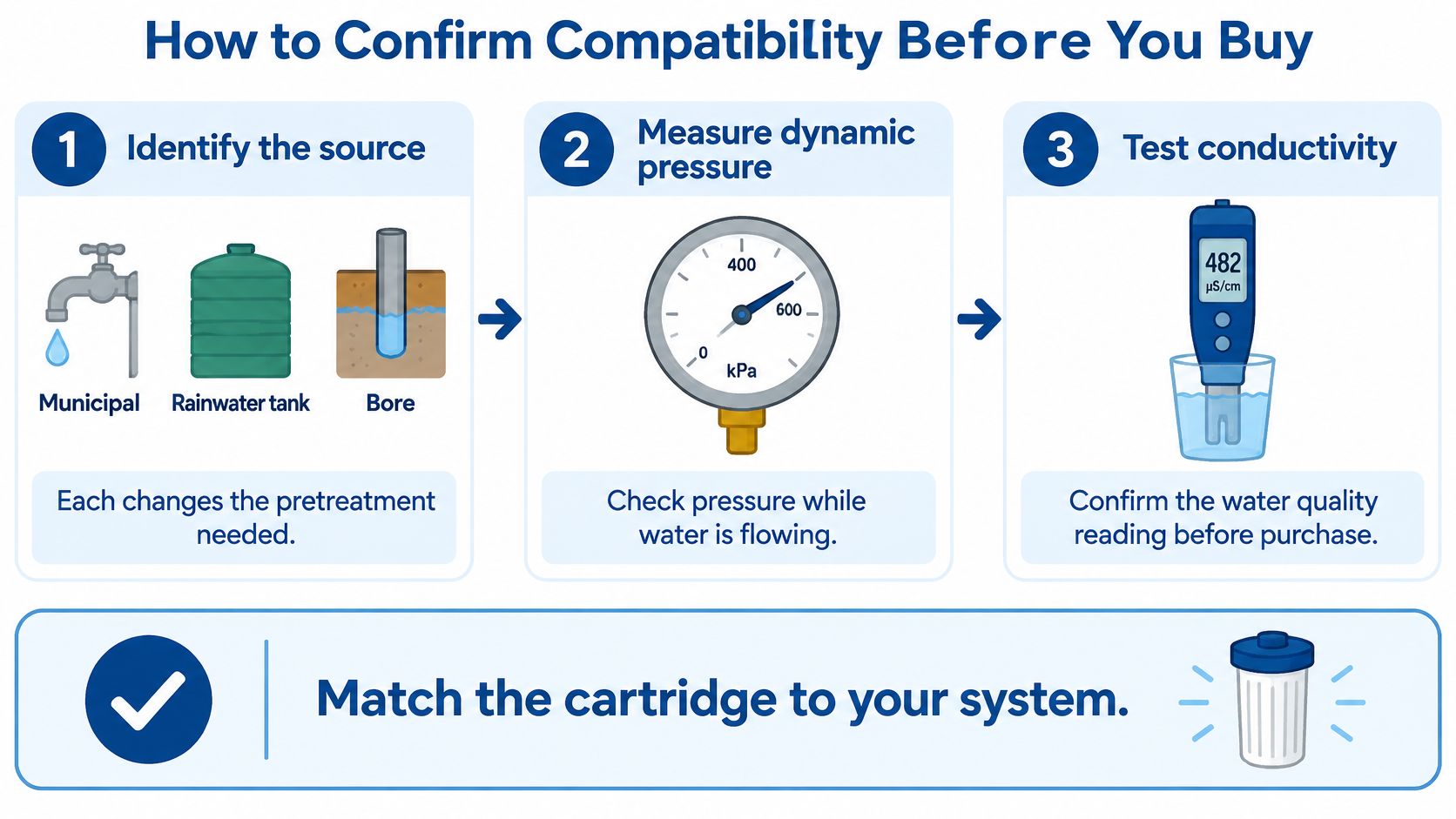
- Identify the source. Municipal, rainwater tank or bore. Each one changes the pretreatment you need, and none of the later steps mean anything until you've named it.
- Measure dynamic pressure at the appliance while a tap is running. Confirm it sits inside 100 to 600 kPa. The common slip is testing static mains pressure at the meter and assuming it holds at the cartridge.
- Note the feed temperature. A cold winter supply produces less permeate from the same membrane, so the reading you take in July isn't the one you'll see in January, and both belong in your log.
- Test the feed water. A conductivity or TDS reading gives you a baseline. On a bore or any high-TDS supply, send a laboratory sample for total dissolved solids and individual salts instead, because some constituents need pretreatment to avoid scaling.
- Confirm the prefilter stages are present. Sediment first, then carbon, so particles and oxidants never reach the membrane. Skipping the feed test on tank water is the second most common mistake.
- Check the product record for AS/NZS 3497 and compare the listed capacity against your actual peak demand, not your average use.
- Plan the space. Isolation valve, service clearance, and drain capacity for reject water. A cartridge you can't reach is a cartridge that gets neglected.
The Reading You Record on Day One
Once the system is running and the storage tank is full, take one more measurement that everything later depends on. Read the feed conductivity, then read the permeate conductivity, using the same meter for both.
Calculate rejection as feed minus permeate, divided by feed. A feed reading of 400 µS/cm and a permeate reading of 20 µS/cm gives you 95 per cent rejection.
Write it on a label: feed value, permeate value, rejection percentage and the date, taped inside the cabinet door. That percentage, not a calendar date, is the number every future decision gets measured against.
Diagnosing Low Flow, Taste and Rejection Problems
A tap that slows over several months is usually describing an upstream restriction, not a tired membrane. The membrane is the fine sieve at the end of the line. If sediment or carbon before it packs down, the sieve receives less water, and the faucet shows the problem first.
| Symptom | Likely cause | First check |
|---|---|---|
| Flow drops slowly over months | Clogged sediment or carbon prefilter | Replace the prefilter before the membrane |
| Flow drops suddenly at normal pressure | Membrane fouling or scaling | Compare feed and permeate conductivity |
| Taste returns or permeate reading rises | Reduced salt rejection or membrane damage | Inspect the membrane and sanitise or replace |
| Low flow with low dynamic pressure | Undersized supply or faulty tank | Measure pressure while water runs |
| Reject water drains slowly | Blocked drain line or restrictor | Clear the line and check reject flow |
Read that table like a set of traffic signals. A slow fade over months points to the prefilter stage. Sediment cartridges load up, flow falls, and the membrane gets blamed for a restriction sitting upstream of it. Change the prefilter, wait a day, and measure again before you order anything else. This keeps the diagnostic order simple: clear the coarse filter first, then judge the fine one.
A sudden drop at unchanged pressure and temperature points at the membrane itself. That is when your commissioning figure earns its keep. Compare today's permeate conductivity with the number on the label. A clear rise tells you rejection has fallen, and the membrane needs inspection, sanitising or replacement in that order. This works because the label records the system as it performed on the day it was commissioned, including the local feed water it had to handle.
Taste that returns after months of good performance is the same signal arriving through your tongue instead of a meter. It means dissolved content is getting through, which means the membrane is compromised or the flow path has changed. Taste can also pull attention toward the wrong part, because reverse osmosis does not soften water in the way many people expect. If hardness was part of the original complaint, the membrane may be doing its job while another part of the treatment plan is missing. Confirm with the meter before buying a new cartridge.
Two of these faults cost nothing to chase. Reading the label inside the cabinet is free, and so is pulling the drain line to check for a kink or a blocked restrictor. Clearing a drain or swapping a prefilter is an afternoon's work. Confirming a membrane fault properly takes about a week of logged pressure and conductivity readings, because a single reading can catch a system mid-cycle and tell you nothing.
The fork worth remembering: slow decline over months is a prefilter problem. Sudden decline at steady pressure is a membrane problem.
Deciding When to Replace Your Cartridge
Replacement timing follows performance and local conditions rather than a printed interval. HealthyWA's guidance on water filters for the home advises following the manufacturer's instructions, including periodic cartridge changes, and says clogged filters need disposal and replacement. What it can't give a Melbourne household is a rule for telling a finished RO membrane apart from a pair of tired prefilters sitting in front of it.
That distinction lives in the label. Feed and product readings, rejection percentage, pressure and flow, recorded at commissioning and checked again before you spend, separate the two suspects.
| Water condition | Typical membrane life | Replacement signal |
|---|---|---|
| Softer water, low sediment | 24–36 months as a rule of thumb | Rejection falls below your recorded baseline |
| Higher scaling or hard water | Sooner than 24 months | Flow and rejection decline together, ahead of the baseline |
| Sediment-heavy supply | Depends on prefilter care | Prefilter blocks often; change it first, then re-measure |
| Tank or bore water with high total dissolved solids | Set only after testing | Test total dissolved solids before assuming any interval |
Price won't tell you when to replace, but it sets the stakes for the decision. A 50 GPD replacement membrane was listed at USD 39.00 in 2026 from Crystal Quest, and a 2.5 inch by 14 inch freshwater membrane at USD 153.75 from the same supplier's freshwater range. Neither listing is Australia-specific, so read them as a band, not a quote. What you pay is set by the part number on your housing label.
Treat that first row as a rule of thumb for softer water, nothing more. Scale layers onto the membrane surface and drags flow and rejection down together, which is why harder water pulls the date forward. Water hardness, total dissolved solids, sediment loading, household usage and prefilter quality are the variables that move it. No cartridge-size chart can tell you when yours is due, because the chart never saw your water.
Prefilters go out far more often than the membrane, and they should. Every sediment and carbon change buys membrane life by keeping grit and chlorine off the surface. Run the prefilter schedule as the maintenance plan, and let the membrane go only when the rejection number says so.
What to Do With a Membrane You've Removed
Ask the supplier whether they take used membranes back before you assume a kerbside collection will handle it. The return path, where one exists, runs through the supplier rather than the bin, so the question costs a phone call and can save a wasted trip to the transfer station.
When the reading stays unclear, the last step isn't another cartridge. A licensed plumber can verify dynamic pressure at the appliance and check the housing connection, seals and drain arrangement, which is often where a membrane that looks finished turns out to be a fitting problem.
Work through it in this order:
- Read the label and compare today's permeate figure with your commissioning reading.
- Swap the sediment and carbon prefilters before you judge the membrane.
- Re-measure rejection after a week of normal use.
- Buy a membrane only if rejection is still down against your baseline.
- Call a licensed plumber or installer if pressure or fittings are in doubt, before you buy anything.
If your under-sink or whole-house filtration needs to fit inside new cabinetry, a tight service space or a fresh renovation, Elite Bathroom Renovations Melbourne coordinates the licensed plumbing, cabinetry and waterproofing work that leaves a cartridge easy to reach and easy to service. Visit Elite Bathroom Renovations Melbourne to talk through your kitchen or bathroom project before you buy the hardware.
