
You've pulled the white canister out from under the sink, and the listing just says "RO membrane", as if that label settled the choice. The water might be chlorinated Melbourne mains, a rainwater tank, a caravan supply, or the feed to a boiling-water tap in a small office. Those are different jobs, and the wrong sheet of plastic will either let salt through, clog, or fall apart the first time it meets chlorine.
Reverse osmosis membrane types are chosen by the contaminant you have, the pressure at the tap, and whether a disinfectant is still in the water. A high rejection rating on a box is not a water test.
Table of Contents
- Reverse Osmosis Membrane Types at a Glance
- How Membrane Structure Creates the Flow and Rejection Trade-Off
- Matching the Membrane to the Contaminant You Have
- The Modern Default
- Nanofiltration and Low-Pressure Membranes for Softening
- Where Each Membrane Type Is Applied in Practice
- Choosing Your Membrane and Confirming the Install
Reverse Osmosis Membrane Types at a Glance
For an Australian home or a light-commercial drinking-water unit, the practical default is a thin-film composite (TFC) polyamide membrane in a spiral-wound element. Older cellulose acetate film still exists, and it is the one to look at when a little chlorine will reach the membrane. Nanofiltration (NF) and low-pressure TFC are the pick when you want hardness down, not near-total desalination. Seawater elements are a different tool again: denser polyamide, built for pressures no household tap can supply.
The ranges below are typical figures under standard test conditions. They are not a guarantee for your tap, your temperature, or a membrane that is three years old.
| Membrane type | Structure and material | Typical salt rejection | Chlorine tolerance |
|---|---|---|---|
| Standard TFC polyamide (BW30-type) | Thin polyamide layer on porous support, spiral-wound | Higher than cellulose acetate on the same salt test | Low, needs dechlorination |
| Seawater TFC polyamide (SW30-type) | Denser polyamide layer, spiral-wound | 99.5%+ | Low, needs dechlorination |
| Low-pressure TFC | Looser polyamide layer, spiral-wound | About 95% multivalent ions, 85% monovalent ions | Low |
| Fouling-resistant TFC | Modified polyamide surface, spiral-wound | Matches standard TFC only when the datasheet says so | Low, check datasheet |
| Cellulose acetate | Asymmetric cellulose ester film | 85-95% | Moderate, tolerates low chlorine |
| Hollow fibre | Bundle of fine hollow fibres | No single residential figure; read the element datasheet | Read the element datasheet |
| Nanofiltration (NF) | Looser TFC layer | About 75% multivalent ions, 30% monovalent ions | Low |
How to use the table
Start with the chlorine column if the supply is town water. A TFC surface that sees free chlorine or chloramine oxidises. Carbon has to sit in front of it. Only after that do you compare rejection with the contaminant you care about, which is a later decision than the marketing litres-per-day number.
Practical rule: If you cannot say whether chlorine or chloramine is still in the water, you are not ready to pick a membrane.
BW30-type names point at brackish or town-water elements. SW30-type names point at seawater. Fouling-resistant elements use a modified polyamide face so iron, manganese and organic matter stick less readily. Their rejection and chlorine limit still have to come off that element's datasheet, not from the family name. Hollow-fibre bundles were an early packing method. They are not what you will find in a normal under-sink housing in Melbourne.
How Membrane Structure Creates the Flow and Rejection Trade-Off
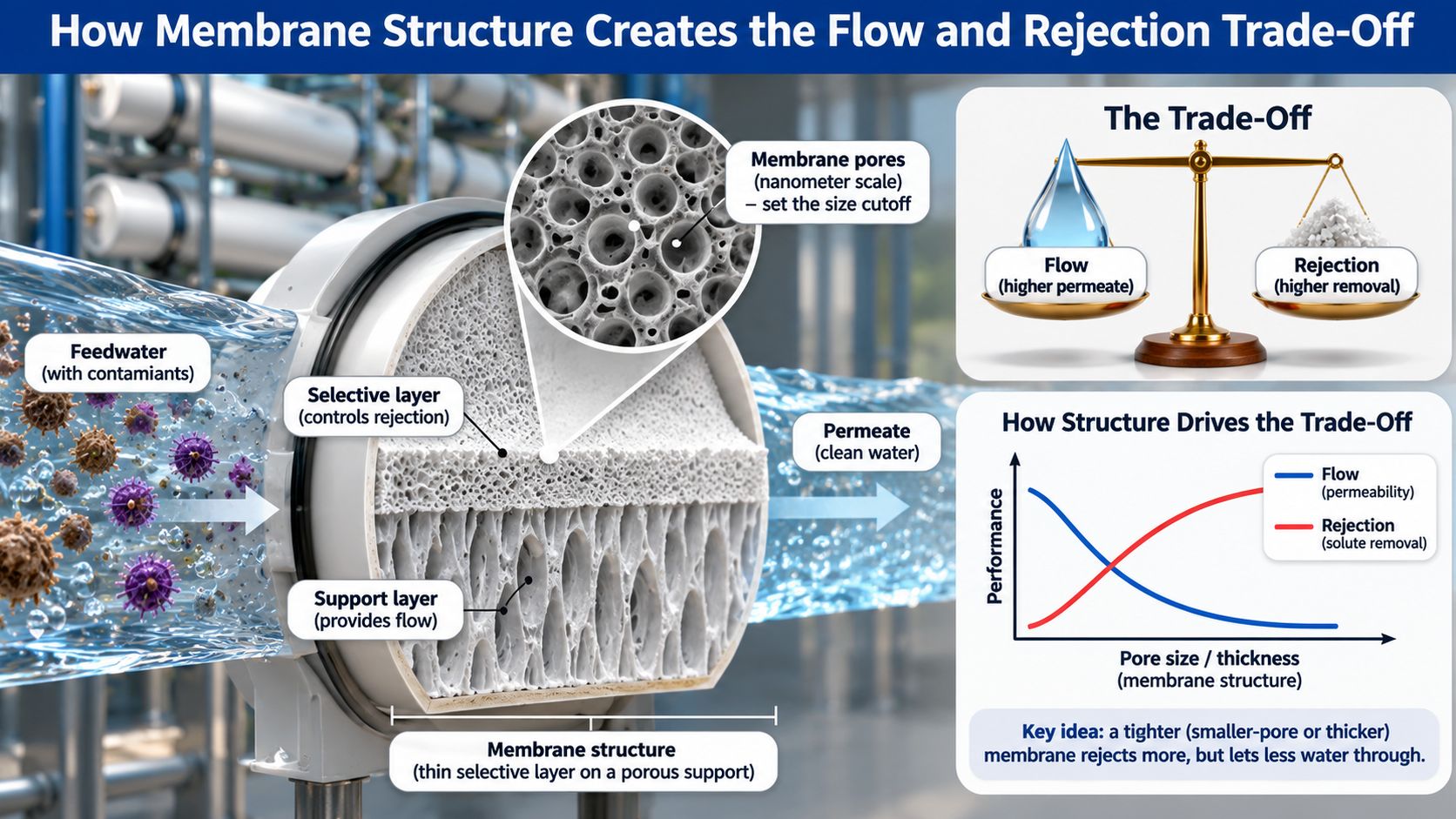
Think of the membrane as a crowded doorway. Water molecules slip through. Salt ions get turned back. Pressure is the shove that keeps water moving across.
A thin skin on a sponge
The selective skin is extremely thin. It sits on a porous support that gives strength without doing the salt rejection. Spiral-wound construction wraps flat sheets, with a feed spacer and a permeate spacer, around a perforated centre tube. That is how a small housing holds a large area of membrane. Feed runs along the sheet. Clean water spirals inward to the centre tube. The salty remainder leaves the other end as reject, or concentrate.
Hollow-fibre bundles pack the area differently, as thousands of fine tubes. They can be compact, and they foul more easily when the feed carries silt, iron or organic slime, because the flow paths are narrow and harder to flush. That packing choice is why spiral-wound TFC became the housing you buy for a kitchen or a small plant.
Tighter skin, more pressure
A tighter skin rejects more dissolved salt and needs more pressure to push the same volume through. A looser skin makes more water at lower pressure and lets more salt through. That is the whole trade-off behind low-pressure TFC, standard brackish elements and seawater elements. Same family of plastic, different tightness.
Recovery is the share of feed that becomes drinking water. Say the unit takes 1 litre of feed at 50% recovery. You get 0.5 litres of permeate and 0.5 litres of reject down the drain. Push recovery higher and the water left on the feed side gets saltier, which raises the chance of scale on the sheet. Drop recovery and you waste more water to protect the membrane.
Fouling-resistant TFC keeps the polyamide chemistry and changes the surface so it is smoother or differently charged. Iron, manganese and natural organic matter adhere more slowly, which suits a bore or a surface supply that marks a standard element brown within months. It does not magically tolerate chlorine, and it does not automatically match the rejection of a high-rejection brackish element. Both numbers belong on the datasheet for that model.
What a spec sheet is actually saying
Higher rejection paired with lower flow, at the same test pressure, means a tighter membrane. A litres-per-day rating with no test pressure, no temperature and no feed salinity tells you very little. Cold winter water in a Melbourne kitchen produces less permeate than the warm test condition printed on the label. If the sheet lists flow and stays silent on pressure, ask for the test pressure before you compare two cartridges.
A flow rating without a pressure figure is an advertisement, not a specification.
Matching the Membrane to the Contaminant You Have
The letters "RO" do not tell you what will come out of the tap. Rejection changes with the contaminant, the feed chemistry, the pressure, the flow and the age of the sheet. A membrane sold for high total-dissolved-solids rejection is not automatically the right answer for every worry on a Melbourne water report.
Australia's NHMRC drinking water guidance states that high-pressure membrane systems are commonly used for PFAS, and that reverse osmosis can achieve more than 99% removal of longer-chain PFAS such as PFOA and PFOS, while it is likely to remove shorter-chain PFAS such as PFBS. The same guidance notes that granular activated carbon and anion exchange are less effective for short-chain PFAS.
The short film below shows how a household unit is plumbed, which makes the pretreatment order easier to picture before you read the rows.
| Contaminant | Membrane response | What to check |
|---|---|---|
| Longer-chain PFAS (PFOA, PFOS) | RO removes more than 99% | Independently verified test results for the specific membrane |
| Shorter-chain PFAS (PFBS) | RO likely removes; carbon and anion exchange weaker | Confirm RO performance for short-chain PFAS |
| Total dissolved salts | RO gives highest rejection; NF gives partial reduction | Feed conductivity and target output |
| Hardness (calcium, magnesium) | NF or RO both reduce; NF often sufficient | Hardness test and target softness |
| Chlorine and chloramine | Damage TFC polyamide surfaces | Pretreatment carbon stage and residual test |
| Iron and manganese | Can foul the membrane | Pretreatment and water test results |
Salts, hardness and PFAS are not the same job
Total dissolved salts are where a tight polyamide RO membrane earns its keep. NF only takes a portion, so a household chasing very low conductivity for drinking should not stop at a softening membrane. Hardness, which is mostly calcium and magnesium, falls with either. If showers, kettles and appliances are the complaint, and drinking water is already acceptable, NF is often enough and wastes less pressure.
PFAS is compound-specific. Longer-chain PFOA and PFOS are the stronger RO result in the NHMRC note. Shorter-chain PFBS is the one where a carbon filter or an anion resin, used alone, is the weaker barrier. Ask for a test on the membrane model you are buying, not a generic claim that "RO removes chemicals". Membrane age, pressure and flow all move that result.
What attacks the sheet before it can filter
Chlorine and chloramine are not contaminants the membrane is meant to "remove" in daily service. They attack a TFC polyamide face. A carbon stage and a residual test come first. Iron and manganese do not always show up in a taste test, and they plate onto the sheet, cutting flow long before salt rejection collapses. A laboratory panel that includes both metals is cheaper than a fouled element six months after install.
Which membrane removes the contaminant I actually have, and what happens when the source water changes?
That second half matters in Melbourne when a property switches between mains and tank, or when a wet year changes bore salinity. A cartridge chosen for last year's report can be the wrong tightness after the supply changes. Retest, then match the class again.
The Modern Default

TFC polyamide became the default for under-sink and light-commercial RO because it wins where a household notices: salt rejection, output for a given size, and energy demand. Comparative data summarised by Europe PMC place cellulose-acetate rejection broadly around 85–95%, while modern polyamide TFC membranes reach substantially higher rejection under suitable operating conditions, with higher water flux, greater mechanical strength and lower energy demand.
Choose it by the job: contaminant, chlorine condition and measured pressure. If the target is dissolved salt and the feed can be dechlorinated and driven properly, polyamide is the stronger daily sheet. That is why a replacement cartridge for an under-sink system, a boiling-water tap or a small office chiller is usually a polyamide spiral element; cellulose acetate is now the niche choice for awkward oxidant exposure.
The cost of that tighter skin
Polyamide works like a finer sieve with a thin working face: water passes fast, dissolved salts stay back, and oxidants scar the face. Chlorine and chloramine in town water need to be gone before the feed reaches the sheet. For a Melbourne install the order is sediment cartridge, then activated carbon sized for the flow, then the membrane. A carbon block that is exhausted is decoration. Prove the residual after the carbon stage, because an upstream meter reading misses what reached the element.
Cellulose acetate still tolerates a low chlorine residual, so it remains in some catalogues. The price is lower rejection and, typically, more pressure or more membrane area for the same jug of water. Match the material to the chlorine condition you have: reliably dechlorinated feed favours polyamide, while a system where carbon might be bypassed or left unchanged fails more gently with cellulose acetate.
Household pressure is the quiet limit
A tighter sheet needs more pressure to hold the same output. If line pressure is marginal, a booster pump belongs in the quote from the start.
Take an under-sink unit rated at a warm test pressure, installed in a kitchen sitting near 40 psi on a winter morning. Permeate falls well short of the advertised litres per day, and a larger share of the feed goes to drain because the membrane is being driven too softly. Cold water tightens the same problem. Select the element against measured feed pressure and measured temperature, in litres per day at those conditions; the largest packet number is the wrong target.
Before paying, ask three questions: where the carbon sits, how chlorine removal will be proven, and what pressure remains at the tap with other fixtures open. If that last number is marginal, price the booster as part of the install.
Nanofiltration and Low-Pressure Membranes for Softening
Full RO is for near-total desalination. NF and low-pressure RO are for hardness and selected ions, at less pressure and usually less energy. Mixing those goals up is how people buy a seawater-tight membrane for a kettle problem.
An Australian remote-community design study, reported in Desalination, compared a low-pressure TFC membrane that retained approximately 95% of multivalent ions and 85% of monovalent ions with an NF-type TFC membrane retaining about 75% and 30%. NF lets far more sodium and chloride through, so it can run at lower pressure. It is the wrong membrane when the target is very low total dissolved solids.
Two households, two answers
Multivalent ions such as calcium and magnesium are what leave scale in a kettle and a shower screen. Monovalent ions such as sodium and chloride dominate the salty taste and the conductivity reading. NF holds back most of the hardness pair and lets much of the monovalent salt pass. Low-pressure TFC sits between that and a tight brackish element: still not a seawater membrane, still more salt rejection than NF.
Picture a house where drinking water is already fine and the complaint is scale on taps and appliances. NF can soften without dragging every dissolved ion down, and the question of whether reverse osmosis softens water is really this split. Picture a second house that wants very low dissolved solids for drinking, a coffee machine or a lab-style jug. Conventional high-rejection RO is the fit. NF will leave a conductivity number that still tastes like the source, only a bit softer.
The same study modelled recoveries from 10% to 95% and found that energy demand changes with raw-water salt concentration, ion retention and recovery. A high recovery on a salty bore saves water and spends more energy fighting a saltier concentrate. A low recovery does the opposite. There is no universal "best" recovery for a Melbourne postcode.
Test before you choose a cartridge
A generic "softening RO" label is weaker evidence than five numbers:
- Hardness: Tells you whether NF is even in the conversation.
- Conductivity or total dissolved solids: Tells you whether partial rejection will miss the drinking-water target.
- Iron and manganese: Flag fouling before you commit to a looser or a tighter sheet.
- Disinfectant residual: Decides whether carbon is mandatory in front of any TFC face.
- A note on recovery: Ask what share of feed becomes product at your salinity, not at the factory's mild test water.
Run those tests, then pick NF, low-pressure TFC or conventional RO. Doing it in the reverse order is how cartridges get returned.
Where Each Membrane Type Is Applied in Practice
Start with the duty, then the pressure, then the chemistry the membrane must survive. A coastal plant and an under-sink cartridge both get labelled “reverse osmosis”, but they are chosen for different contaminants, feed pressures and brine limits.
| Application | Likely membrane | Typical feed pressure | Design note |
|---|---|---|---|
| Under-sink drinking water | Standard TFC polyamide | About 40-80 psi | Low pressure cuts output and increases drain flow |
| Whole-house filtration | Usually carbon or media, not RO | Mains pressure | RO rarely used whole-house because of drain volume |
| Caravan or RV inline RO | Compact standard TFC | Set by a 12-volt pump | Pump-assisted; check pump rating |
| Commercial chilled or boiling-water units | Standard TFC polyamide | Mains with booster | Booster needed where pressure is marginal |
| Brackish-water treatment | BW30-type TFC polyamide | About 150-400 psi | Moderate pressure, inland sources |
| Seawater desalination | SW30-type TFC polyamide | About 800-1,000 psi | Two-stage designs, such as Wonthaggi, manage brine |
From the kitchen to the van
An under-sink drinking-water unit on town water uses a standard TFC element in a low municipal-pressure band. If the gauge sits below the element's working window, the result is less permeate and a worse reject ratio, so the “same” water takes longer and wastes more. Whole-house treatment almost never uses RO for that reason: sending a large share of household flow to a drain all day becomes a plumbing and water-bill problem. Carbon and media handle chlorine, taste and sediment at mains pressure without that loss.
A caravan or RV inline unit is the same chemistry in a smaller housing, pushed by a 12-volt pump. Match the pump's rated pressure to the membrane's test pressure. A pump that cannot reach the element's design point can look like a failed membrane when the sheet is underfed. Cafe and office chilled or boiling-water taps also use standard TFC, with a booster where riser pressure sags at peak times. The manufacturer's pressure window overrides any band in a table.
Brackish bores and the coast
Inland brackish sources sit in the middle: salty enough that carbon and softening will not fix the complaint, mild enough that a seawater skin is wasted money. BW30-type polyamide fits that duty. Seawater elements are built for much higher pressure because ocean salt loading needs more force to push water through a tighter skin. Put an SW30-type element on mild town water and you pay for pressure you did not need, often with lower flow than the tap could have supported.
Australian plants show the scale those seawater elements are built for. The Australian Bureau of Statistics records that Perth's Kwinana desalination plant began producing 130 megalitres a day in late 2006, about one-fifth of Perth's water use at the time, through a synthetic membrane that passed water and held back salt. Victoria's Wonthaggi plant uses two stages of reverse osmosis and has a maximum capacity of 150 gigalitres a year, or 150 billion litres. A kitchen cartridge uses the same selective-sheet idea at household pressure and a brine volume you can route to a drain. Choose it by the contaminant, pressure and chlorine residual in front of it, then give the reject stream a lawful place to go.
Choosing Your Membrane and Confirming the Install
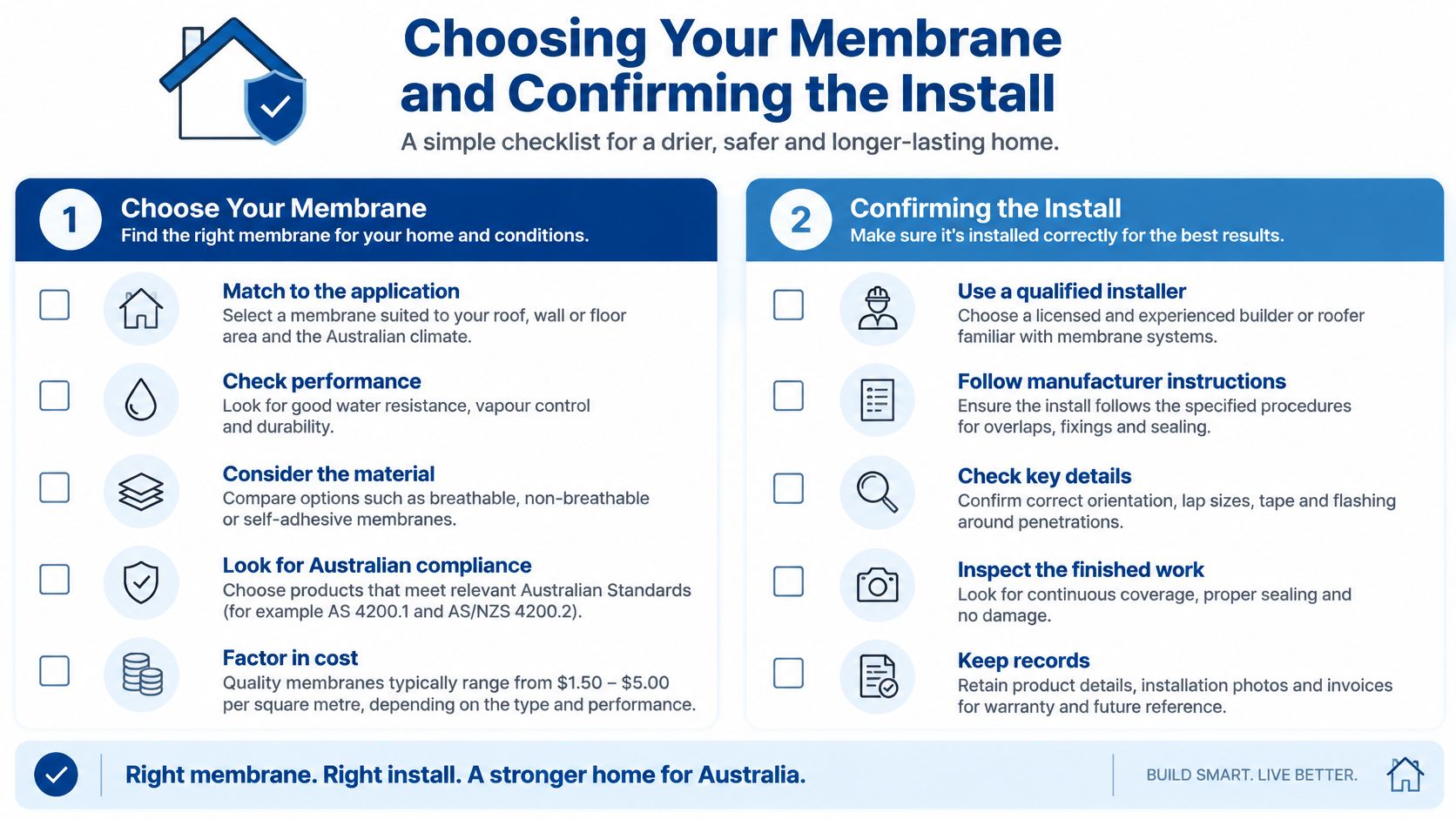
A cartridge can look correct on the box and still be wrong for the tap it feeds. Choose by the contaminant, the feed pressure and the chlorine level in your water, rather than the generic RO label, then confirm the install can support that choice.
Work down this list before you pay for a cartridge. Skipping a step is how a tight membrane gets installed on water it cannot survive, or a softener-style NF membrane gets installed when the complaint was salt.
- Gather the tests. Hardness, total dissolved solids, PFAS if that is the concern, chlorine or chloramine, iron and manganese. Taste alone cannot tell you which class of membrane belongs under the sink.
- Match the class to the worst result before you read the RO label. Standard TFC when you need near-total desalination. Low-pressure TFC or NF when softening is the actual goal.
- Measure pressure at the tap with a simple gauge. Below about 40 psi, put a booster in the quote before you compare cartridge prices, because an underfed element reads as a bad element.
- Fix the pretreatment order. Sediment first, activated carbon for chlorine and chloramine second, membrane third. Nothing else belongs between carbon and the sheet unless the supplier can explain it.
- Check recovery and the drain point. At 50% recovery the unit sends one litre to waste for every litre you drink. Confirm the reject line has a lawful, practical place to go, especially in a unit or a van.
- Ask for independent certification, such as NSF/ANSI 58, and for contaminant-specific results on the element model. A brochure sentence about "up to 99%" is weaker than a model-specific result.
- Ask about replacement interval and end of life. How many months, who changes it, and whether a used element is recycled or binned. Serviceability matters as much as first-day rejection.
- Confirm who touches the pipes. New pipework should be done by a licensed local plumber, with the scope written down before anyone cuts a wall.
If the quote names a membrane and stays silent on pressure, carbon and the drain, it is not finished.
That written scope is the single next step. Agree what is included, who is licensed to do the plumbing, and which test results the membrane was chosen against. Then buy the element.
If the membrane choice is part of a new vanity, a boiling-water tap or a full bathroom refit, Elite Bathroom Renovations Melbourne coordinates the licensed plumbing with the rest of the fit-out so the filter, the tap and the cabinetry are planned together. The team handles bathroom renovations across Melbourne, including the pipework around under-sink treatment. Visit Elite Bathroom Renovations Melbourne to talk through the scope before work starts.

Pingback: Whole House Water Filters Australia: What Actually Works