

Your shower smells of chlorine, but the kitchen tap tastes fine. You're planning a renovation and wondering whether to add a filter under the sink or treat the entire house. Then you start comparing systems and find that almost every supplier promises cleaner water, without making clear which contaminants their equipment reduces.
The useful question isn't which whole-house filter is best. It's which treatment stages your water needs, and where you need the treated water. For some Australian households, that means a sediment-and-carbon system at the property's entry point. For others, a validated drinking-water filter is the more practical, less costly choice.
Table of Contents
- How Whole House Filters Work Across the Home
- The Filter Stages and What Each One Removes
- Certification Labels Worth Checking Before You Buy
- How to Install a Whole House Filter Safely
- When a Whole House Filter Is and Is Not Worth It
- Sizing, Running Costs and Cartridge Replacement
- Confirm the Water Test Before You Buy
How Whole House Filters Work Across the Home
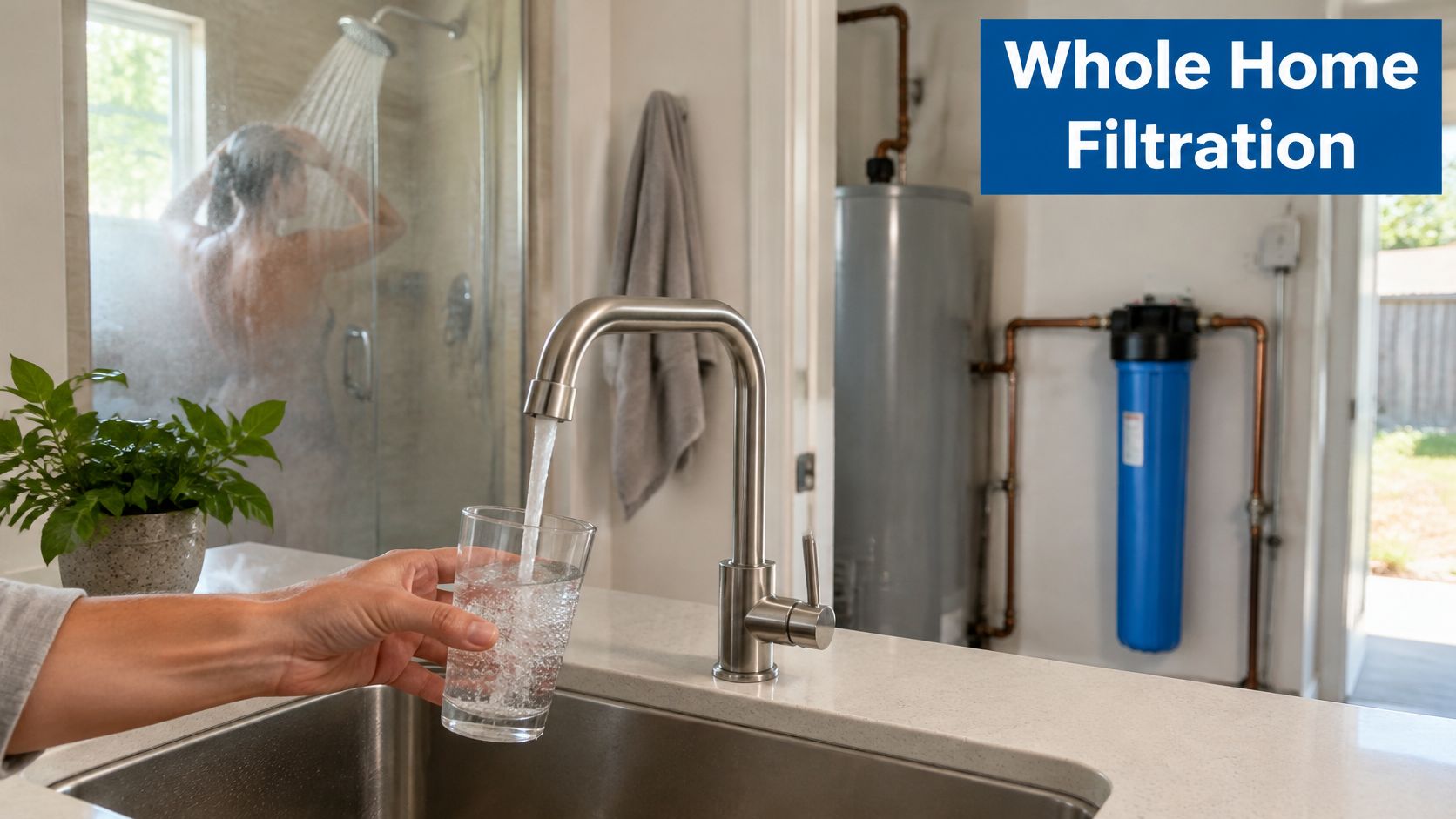
Follow the water from the street into your property. It passes through the main isolation valve, then branches towards the kitchen, bathrooms, laundry and water heater. A whole-house filter, also called a point-of-entry system, sits before those branches so the connected outlets receive treated water.
Think of it as a checkpoint at the front gate rather than a guard at each room door. That arrangement can address a concern across the property, but it also means the system must cope when several outlets run together. A cartridge suitable for a dedicated drinking tap isn't automatically suitable for a busy household.
The distinction is easier to understand when you compare treatment locations.
Whole-house coverage isn't the same as drinking-water filtration
Australian households have used drinking-water filters for years. The Australian Bureau of Statistics reported that more than 32% of households used a filter for drinking water in 2010, compared with 21% in 2001.
That historical benchmark includes drinking-water filters, not just whole-house installations. A jug, countertop appliance or under-sink cartridge answers a different question from equipment treating shower and laundry water.
- Point-of-use treatment serves a selected outlet, such as a dedicated kitchen drinking tap.
- Point-of-entry treatment serves the pipework downstream of the installation.
- Excluded branches can leave irrigation or other selected outlets untreated, if the plumber designs the arrangement that way.
For the household with a chlorine-smelling shower, kitchen-only treatment won't change the bathroom water. But if everyone's happy with the showers and the concern is confined to drinking water, treating every outlet may add equipment and maintenance without solving an additional problem.
Coverage describes where treatment happens, not how thoroughly water is treated. The media, certified contaminant claims, operating conditions and maintenance determine what the system can achieve.
The Filter Stages and What Each One Removes
Filter stages, media and what each removes
| Stage | Filter media | Removes well | Does not remove well |
|---|---|---|---|
| Sediment prefilter | Pleated or spun polypropylene | Sand, rust, grit and silt | Chlorine, dissolved metals and bacteria |
| Granular activated carbon | Coconut shell carbon | Chlorine, taste and odour, some organic chemicals | Fine particles and most metals |
| Carbon block | Compressed activated carbon | Chlorine, taste and odour, finer particles, some organic chemicals | Dissolved salts and bacteria unless rated for them |
| KDF media | Copper-zinc alloy | Chlorine and selected dissolved metals when validated | Fine particles and PFAS |
| Ceramic | Fine-pore ceramic | Particles, and some bacteria and cysts when pores are small enough | Chlorine and dissolved chemicals |
| UV disinfection | Ultraviolet lamp | Inactivates bacteria and viruses under validated operating conditions | Particles, chemicals and taste |
Read this table as a guide to treatment roles, not a guarantee for every cartridge containing those materials. A manufacturer still needs to substantiate the particular reduction claim for its product.
A sediment cartridge goes first because suspended material can clog the treatment stages behind it. Pleated cartridges provide a folded filtering surface, while spun polypropylene cartridges capture particles through their structure. Neither should be mistaken for a chemical-removal stage.
Carbon tackles a different task. Granular activated carbon and carbon block can reduce chlorine, unwanted taste and odour, and certain organic chemicals. A carbon block can also capture particles, but its particle performance doesn't establish which dissolved contaminants it removes.
Match the medium to the problem
KDF is a copper-zinc treatment medium, not a universal metals filter. If lead or another metal is the concern, ask for validation naming that metal rather than accepting a general claim about heavy metals.
Ceramic elements use small pores to physically retain particles and, in suitable products, microorganisms. UV takes another approach: it inactivates susceptible microorganisms rather than straining them out. The water must meet the unit's operating requirements, including adequate clarity, for that process to work reliably.
Practical rule: Visible grit suggests particle filtration. Chlorine taste suggests an appropriate carbon stage. A microbial hazard calls for a validated microbial treatment strategy, not simply another cartridge.
Why finer isn't automatically better
A nominal micron rating describes particle filtration characteristics. It doesn't tell you whether a cartridge reduces dissolved lead, PFAS or salts, and it shouldn't be read as an absolute barrier claim.
Flow matters too. Pushing water through treatment media too quickly can shorten contact time and reduce removal, even when the shower pressure feels satisfactory. Ask for contaminant-reduction performance at the intended operating flow, not just the housing's maximum throughput.
If your concern involves dissolved substances, compare the treatment mechanism rather than adding progressively finer sediment cartridges. This guide to reverse-osmosis membrane types can help distinguish membrane treatment from conventional whole-house sediment and carbon filtration.
Certification Labels Worth Checking Before You Buy
A box saying it removes contaminants isn't the same as a certificate showing which contaminants were tested. Certification needs to match the exact model, cartridge and claim, not merely the brand or a component inside the housing.
For filters used for health reasons, NSW Health's private-water supply guidelines recommend an appropriate standard such as AS/NZS 4348:1995 or NSF/ANSI 53; the guidance also identifies turbidity targets below 1 NTU for effective disinfection and below 0.2 NTU for effective filtration of Cryptosporidium and Giardia.
Those turbidity targets describe treatment conditions, not proof that an ordinary sediment cartridge makes water microbiologically safe. NTU measures cloudiness caused by suspended material. Clear-looking water can still contain microorganisms or dissolved chemicals.
What the labels tell you
AS/NZS 4348 addresses domestic water-treatment appliance performance. NSF/ANSI 53 concerns health-related contaminant reduction, but you still need to check the specific reduction claims covered by the product's certification.
WaterMark concerns plumbing-product conformity. NSW guidance recommends WaterMark or the Plumbing Safety Type Test Mark for rainwater and private-supply filtration equipment. Don't interpret a plumbing conformity mark as evidence that a filter removes every contaminant advertised beside it.
A useful supplier conversation starts with documentation rather than reassurance:
- Exact model and cartridge: Ask for identifiers that match the equipment in the quotation.
- Applicable standard: Request the certificate or listing, including its scope.
- Named contaminants: Check that your target substance or organism is explicitly covered.
- Rated treatment flow: Confirm the flow at which the relevant reduction claim applies.
- Rated capacity: Establish how much water the cartridge can treat under its specified conditions.
- Operating limits: Check feed-water requirements, pressure limits and replacement instructions.
A certificate is useful only when it answers the concern you're buying the filter to address.
Be cautious if the salesperson offers a long contaminant list but can't connect it to the proposed cartridge's documentation. Also question claims that combine plumbing approval, particle size and chemical removal as though they were interchangeable. They answer different questions.
How to Install a Whole House Filter Safely
Installation changes the property's drinking-water plumbing. Have a licensed plumber assess the pipework, pressure, access and applicable installation requirements before you buy equipment.
Start by establishing the treatment objective and the physical route through the property.
Set out the installation before cutting pipe
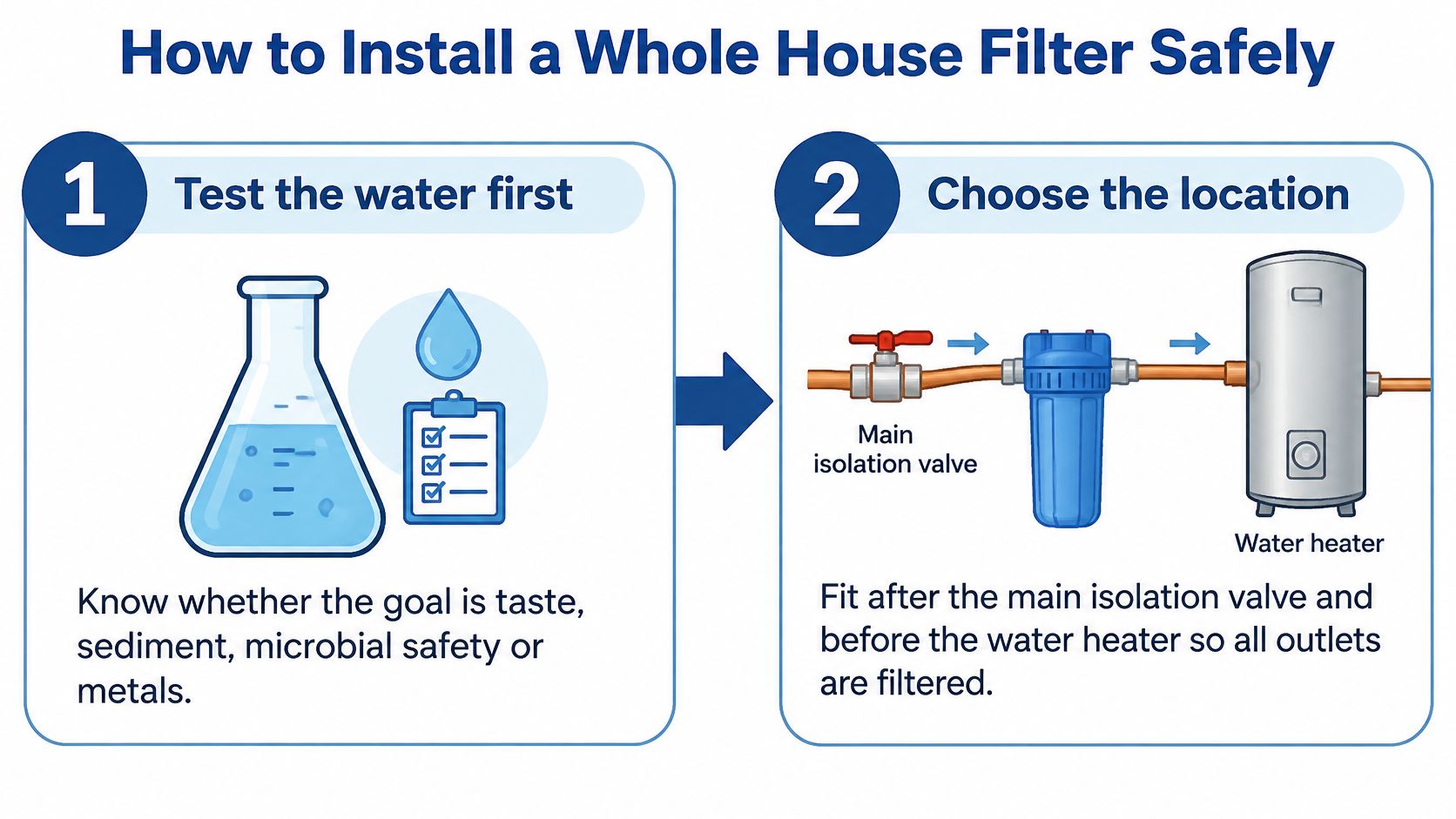
Identify what needs treating. Check the utility report and arrange appropriate laboratory testing where a specific hazard is suspected. Testing should answer a defined question, rather than producing an expensive panel that nobody uses to select the equipment.
Choose the treatment location. Place the system after the main isolation valve and before the water heater and the branches you intend to treat. Ask the plumber to trace existing connections, because an overlooked branch can leave part of the house outside the filtered supply.
Provide isolation and a bypass. Fit valves that allow safe servicing and a clearly labelled bypass arrangement. For a private supply that relies on treatment for safety, bypassing must not send untreated water to drinking outlets.
Arrange the stages correctly. Install the sediment stage ahead of carbon where that configuration suits the treatment design, following each housing's flow arrow. Leave enough space beneath the bowls to remove them without dismantling adjacent pipework.
Check pressure and plumbing compatibility. Have the plumber confirm housing ratings, suitable fittings, mounting support and any pressure-control requirements. Don't assume a substantial-looking bracket or cabinet makes an unsuitable housing safe for the property's operating conditions.
Flush and commission the system. Follow the manufacturer's flushing procedure, then inspect joints and housings for leaks under operating conditions. Skipping the flush can leave loose media or carbon fines in the downstream water.
Create the service record. Record the installed cartridge models, commissioning details and the replacement triggers supplied by the manufacturer. Keep valve instructions and maintenance access information with that record.
Coordinate access with renovation work
Filter bowls need room for a housing spanner, a bucket and cartridge removal. Avoid boxing equipment behind permanent cabinetry or locating it where servicing requires moving a water heater.
If bathroom pipework is already being altered, include filtration access in the bathroom renovation plumbing plan before walls and finishes are closed.
Use the installation video as a visual reference, not a substitute for the product instructions or licensed plumbing work.
When a Whole House Filter Is and Is Not Worth It
A concern about PFAS doesn't automatically justify treating every litre entering your home. In its June 2025 drinking-water guidance update, NHMRC states that most Australian supplies are already below the revised PFAS health-based guideline values and estimates that up to 90% of PFAS exposure in Australia comes from sources other than drinking water.
That national picture doesn't establish the result at your tap. It does challenge the sales pitch that every household needs whole-house filtration primarily for PFAS protection.
Main goal and the system that fits it
| Main goal | Best fit | Why it fits |
|---|---|---|
| Taste and odour at every tap | Whole-house carbon stage | Chlorine is reduced wherever connected water is used |
| Sediment, rust or grit | Sediment prefilter, often with carbon | Protects fixtures and the carbon stage behind it |
| Drinking and cooking water only | Under-sink or dedicated drinking-tap filter | Usually lower cost, with performance checked for one outlet |
| Specific metal or PFAS concern | Validated point-of-use unit after a water test | Treatment is matched to the named contaminant |
| Rainwater tank supply | Multi-stage whole-house system with appropriate disinfection | Addresses microbial hazards identified for the non-mains supply |
| Metals from old internal plumbing | Test first-draw and flushed samples, then decide | The source may be inside the property, not the supply |
Buy treatment where you need it
Say your household wants improved drinking water but has no complaint about bathroom or laundry water. A dedicated kitchen outlet lets you concentrate the treatment budget on a unit validated for that purpose. It also avoids applying that same treatment to toilet flushing and other uses that don't address the concern.
Whole-house treatment becomes more compelling when the objective extends across the property. Examples include recurring incoming sediment, a preference for reduced chlorine throughout the home, or a private supply requiring a coordinated treatment system.
A medically vulnerable occupant may need individual advice about water safety. That's a reason to define the necessary protection carefully, not evidence that any whole-house cartridge will provide it.
Don't confuse separate treatment goals
A filter selected for chlorine or sediment isn't automatically effective against PFAS or lead. For a metal concern, choose a device validated for that particular metal.
Likewise, filtration and softening aren't interchangeable. If scale is the complaint, establish whether hardness treatment is required before buying a carbon system; the explanation of whether reverse osmosis softens water helps separate drinking-water membrane treatment from whole-property hardness control.
Test the relevant water, then compare suitable systems. The right decision starts with the source, contaminant and intended use, not the largest cabinet.
Sizing, Running Costs and Cartridge Replacement
Size a whole-house system for simultaneous demand, not bedroom count or cabinet dimensions. Showers, a filling washing machine and kitchen use can overlap, so the supplier needs to consider the household's realistic peak flow.
Ask for rated treatment flow in litres per minute and cartridge capacity in litres. The housing's hydraulic rating and the cartridge's validated treatment rating may not be the same. A system can deliver an acceptable stream while operating outside the conditions supporting its contaminant-reduction claim.
Compare the complete ownership cost
The purchase price is only part of the commitment. Request a written breakdown covering:
- Initial equipment: Housings, brackets, valves, gauges and the first cartridge set.
- Installation work: Pipe alterations, mounting, protection and commissioning.
- Replacement consumables: Each cartridge, plus any UV lamp or other service component.
- Service labour: What a routine visit includes and which parts cost extra.
- Replacement availability: Whether cartridges are widely available or restricted to a particular supplier.
Don't accept a replacement promise based only on a calendar interval. The schedule should account for manufacturer limits, water quality and the volume treated, with a maximum time limit where specified for hygiene or performance.
Recognise the limits of warning signs
Declining flow, cloudy water or changed taste and odour warrant investigation. However, a cartridge can lose chemical-removal capacity without an obvious change at the tap, so sensory checks aren't a substitute for scheduled servicing.
Maintenance check: At each cartridge change, inspect the housing, clean it using the manufacturer's procedure, examine seals and record what was fitted.
Poorly maintained housings can accumulate deposits or biofilm. If a cartridge blocks unusually quickly, investigate the incoming sediment load and stage selection rather than repeatedly fitting identical replacements.
For property managers, keep the equipment model, service history and supplier details somewhere the next contractor can find them. A filter that nobody knows how to maintain is an avoidable liability, regardless of its original purchase price.
Confirm the Water Test Before You Buy
A utility report describes the supplied water, but it can't identify every change introduced by a property's fittings and pipework. If your concern is a metal at the kitchen tap, the sampling location and collection method matter as much as the laboratory result.
NHMRC's chemical fact-sheet review identifies chemicals leaching from plumbing products as an issue beyond the point of supply. That distinction is particularly important in older properties or buildings where water remains unused for extended periods.
Separate incoming water from internal plumbing
Ask the laboratory whether first-draw and flushed samples are appropriate for the suspected problem. Follow its collection instructions precisely, including any stagnation period, bottle requirements and delivery conditions.
A first-draw sample can help investigate water that has been sitting in contact with local plumbing. A flushed sample can help assess how the result changes after that standing water is displaced, although interpretation still requires context.
An entry-point filter can't remove metal that enters the water farther downstream. Where suspect fittings or pipework are the source, replacement or treatment at the affected drinking outlet may be more appropriate than adding a unit beside the meter.
Turn the findings into a purchase decision
Obtain useful evidence. Start with the latest utility information, then commission targeted testing where the concern requires it. Tell the laboratory whether you're investigating incoming water, a particular tap or a private supply.
Write a plain-language objective. State the intended outcome, such as reducing kitchen drinking-water lead or capturing incoming grit. Avoid an undefined goal of removing everything.
Shortlist documented treatment. Compare products whose certification and operating instructions address that objective. Keep the actual certificates and cartridge identifiers with each quotation.
Confirm the installation design. Have the installer check capacity, pressure suitability, mounting, service clearance and the valve arrangement. Ask who is responsible for commissioning and documenting the completed work.
Arrange maintenance before installation. Identify who will order cartridges, perform servicing and retain the records. Set the first service reminder using the manufacturer's requirements and expected usage.
A renovation can make installation simpler when the relevant pipework is accessible and the layout is still being decided. It's also an opportunity to reserve service space rather than squeezing equipment into a finished cupboard.
When comparing whole house water filters in Australia, choose the system matched to the test result and the household's actual use, not the one with the broadest promise.
Elite Bathroom Renovations Melbourne can coordinate filter placement, plumbing and fittings with your bathroom renovation, using a fully licensed, bonded and insured team working to applicable Australian Standards. Visit Elite Bathroom Renovations Melbourne to discuss your renovation plans, bring your water-test results or treatment objectives, and ask how suitable filtration can fit into the wider plumbing works.
