
Expect to pay somewhere between AUD 10,000 and AUD 35,000 for a bathroom renovation in Melbourne, with a small ensuite at the bottom of that band and a full renovation of a family bathroom toward the top. Where your project lands inside the range is decided by scope, not floor area alone.
The national average reached AUD 26,000 in 2023, up from AUD 21,000, according to the Housing Industry Association as reported by Home Beautiful. That one figure bundles three different jobs: a cosmetic refresh, a same-layout rebuild, and a layout change with new waste runs. Treating it as "the price of a bathroom" is how homeowners anchor themselves to a number that describes almost nobody's actual project.
A quote is a scope document with a price attached. Read it that way and the Melbourne figures stop being confusing. The same small room can land at the bottom of the range or well past the top depending on what sits behind the tiles and whether the toilet moves.
Table of Contents
- Bathroom Renovation Prices in Melbourne at a Glance
- Where the Money Goes in a Bathroom Renovation
- The Factors That Change Your Quote Most
- Victorian Thresholds and Waterproofing Rules That Shape Your Quote
- Hidden Costs and Contingency to Budget For
- How to Compare Bathroom Renovation Quotes Line by Line
- Confirm Your Budget Before You Request a Quote
Bathroom Renovation Prices in Melbourne at a Glance
A small ensuite and a full family bathroom are both sold as "a renovation," yet their budgets can sit AUD 25,000 apart. Split the Melbourne market into three scope tiers and the spread stops looking random: AUD 10,000–25,000 for a small ensuite, AUD 15,000–30,000 for a mid-range full bathroom and AUD 18,000–35,000 for a typical full renovation.
Every band assumes professional labour, a compliant waterproofing membrane and a genuine strip-out.
| Project type | Indicative cost (AUD) | Typical scope | Basis |
|---|---|---|---|
| Small ensuite renovation | 10,000–25,000 | Same layout, new tiling, vanity, shower and waterproofing | Indicative range for the scope tier |
| Mid-range full bathroom | 15,000–30,000 | Full strip-out with existing toilet, shower and vanity positions kept | Indicative range for the scope tier |
| Typical full Melbourne renovation | 18,000–35,000 | Full renovation to finish, layout may or may not change | Indicative range for the scope tier |
| Master bathroom median (2023) | 19,000 | Median national spend on a master bathroom | Houzz 2023 Australia study |
| National average (2023) | 26,000 | Average cost across project types, up from 21,000 | HIA, reported by Home Beautiful |
The three Melbourne rows are indicative planning ranges set by scope, and a quote priced below the bottom of its band for the same job has usually excluded work, most often waterproofing, demolition or reinstatement, rather than found a cheaper way to deliver it.
Read the table as a map of scope tiers. Most arguments about bathroom pricing come from comparing a row that says "same layout" against a quote that includes new waste runs, a relocated shower and a rebuilt floor.
What moves a project between rows
Keeping the toilet, shower and vanity where they are is the largest lever in most Melbourne homes. It holds demolition inside the room, leaves the slab and wall framing alone and lets the plumber connect to existing services rather than chase new falls through a concrete floor. Move any one of them and the quote gains pipework, floor repair and a larger membrane area.
The second lever is finish level. Large-format porcelain, a frameless screen, a stone-top vanity and floor-to-ceiling tiling in the shower all lift the total without touching the plumbing, and none of them registers in a per-square-metre rate.
Why national benchmarks sit where they do
The table carries two national figures and they measure different things. The Houzz 2023 Australia study reports a median, the middle value of the master bathrooms in its sample, so it describes a typical project rather than the cheapest or the dearest. The HIA figure is an average across project types, which pulls it upward whenever layout changes and premium finishes are in the mix.
Samples differ too, as do the definitions of "small," "primary" and "renovated." A national benchmark can tell you whether your quote sits in the right ballpark. It cannot tell you whether waterproofing, demolition and reinstatement are inside the number.
Three questions that decide which row applies
- Is the layout changing? If the toilet, shower or vanity moves, add plumbing relocation, extra demolition, slab or wall access and reinstatement tiling before you compare totals.
- Is the whole wet area being rebuilt? A strip-out to the studs means new waterproofing, new substrate and new sheeting, regardless of how the room looks afterwards.
- Is the finish premium? Natural stone, custom joinery and frameless glass sit outside every mid-range band.
Answer those three and you have selected a row. Only a scope-based quote confirms the number inside it.
Where the Money Goes in a Bathroom Renovation
A total price tells you nothing about value. A breakdown tells you where the risk sits, which is why the useful number is the share each trade takes, not the headline. A realistic Melbourne allocation runs roughly 20–25% for plumbing, 20–25% for tile supply and installation, 5–10% for waterproofing and about 10% for electrical work, according to a bathroom renovation cost breakdown for Australia.
On a AUD 20,000 project, that puts plumbing and tiling at roughly AUD 4,000–5,000 each, waterproofing at AUD 1,000–2,000 and electrical at around AUD 2,000, before fixtures, cabinetry, demolition and overheads take their share.
| Cost line | Share of budget | On a AUD 20,000 project | What moves it |
|---|---|---|---|
| Plumbing | 20–25% | AUD 4,000–5,000 | Rerouting waste pipes or water services adds labour |
| Tile supply and installation | 20–25% | AUD 4,000–5,000 | Tile size, feature walls and preparation |
| Waterproofing | 5–10% | AUD 1,000–2,000 | Substrate condition, shower layout and floor construction |
| Electrical | About 10% | About AUD 2,000 | Lighting, exhaust fan and new circuits |
| Demolition, cabinetry, fixtures and overheads | Remaining share | Balance of the budget | Strip-out, vanity, glazing and project management |
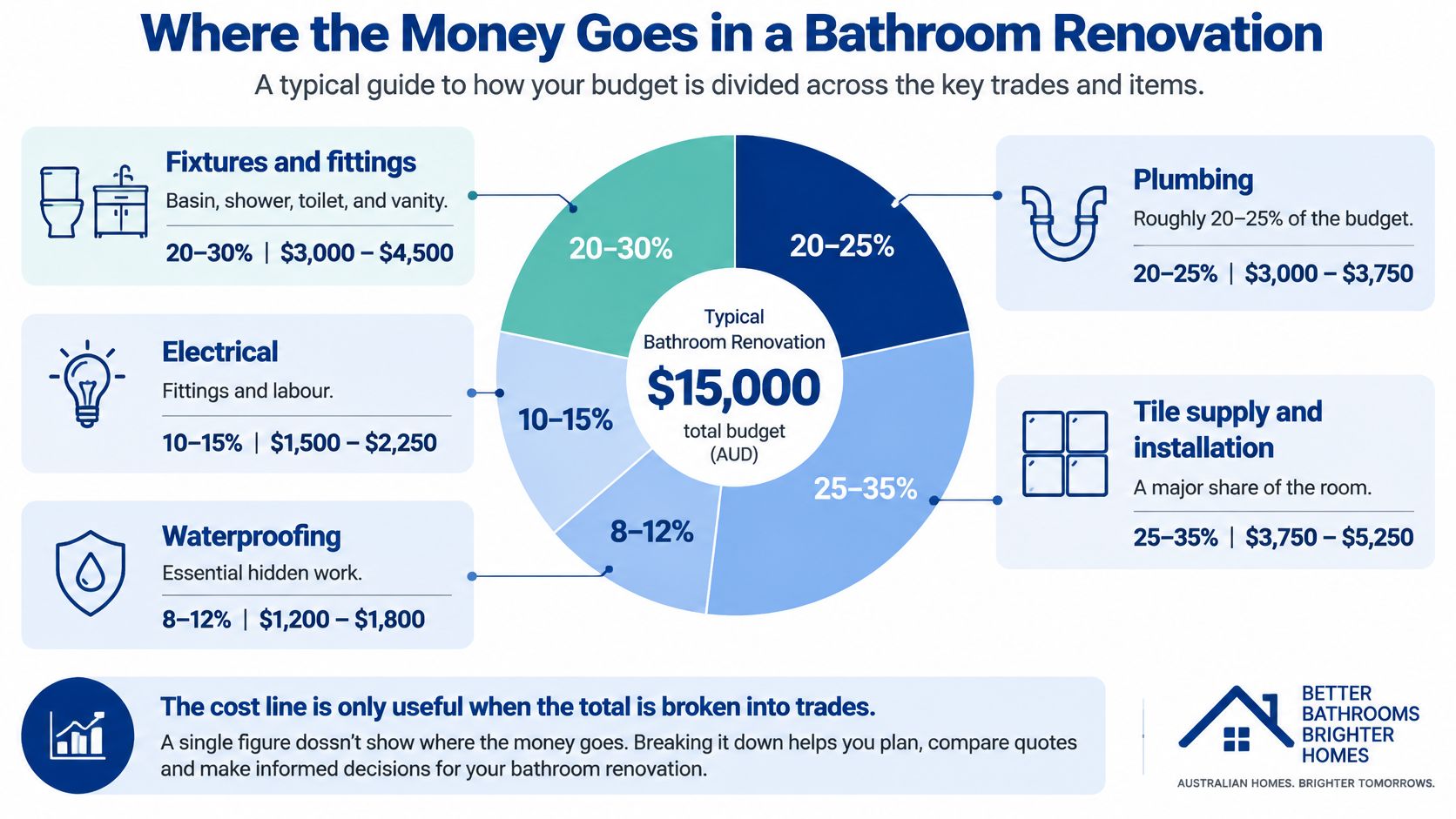
The lines at the bottom of that table are the ones quotes leave vague. Demolition, cabinetry, glazing, fixtures and project overheads soak up the remaining share, and a price that lists them as a lump sum is where a comparison falls apart.
A cost line is only useful when the total is broken into trades. A single lump sum hides which trades were quoted and which were assumed.
One change that moves several lines at once
Relocate a waste pipe and the effect ripples. Plumbing labour rises because the drain needs a new fall and a new connection. Demolition rises because the floor or wall has to open. Tiling rises because the reinstated patch needs matching and the layout shifts. Waterproofing rises because new penetrations need new detailing.
Tile choice behaves the same way. The material is only half the line, because tiling works in Melbourne bathrooms carry the preparation: levelling, backer board, cutting around wastes and setting out so the grout lines land somewhere sensible. Large-format tiles and feature walls need more of all four.
Take the breakdown to your contractor and ask which lines sit outside the ranges above. An answer about scope is a good sign. A shrug is not.
The Factors That Change Your Quote Most
Houzz reported in its Australian renovation trends study that bathrooms under 5 square metres averaged AU$9,700 to renovate in 2017, against AU$13,200 for larger rooms, a gap of AU$3,500 or roughly 36%. Use the gap as evidence that size matters and as a warning against quoting old survey figures as current pricing.
The same survey places bathrooms near the centre of renovation spending, with master bathrooms among the most prioritised rooms and interior work accounting for most activity. The practical lesson is narrower: floor area sets the quantity of tiles, sheeting and labour, while scope sets how difficult those quantities are to install.
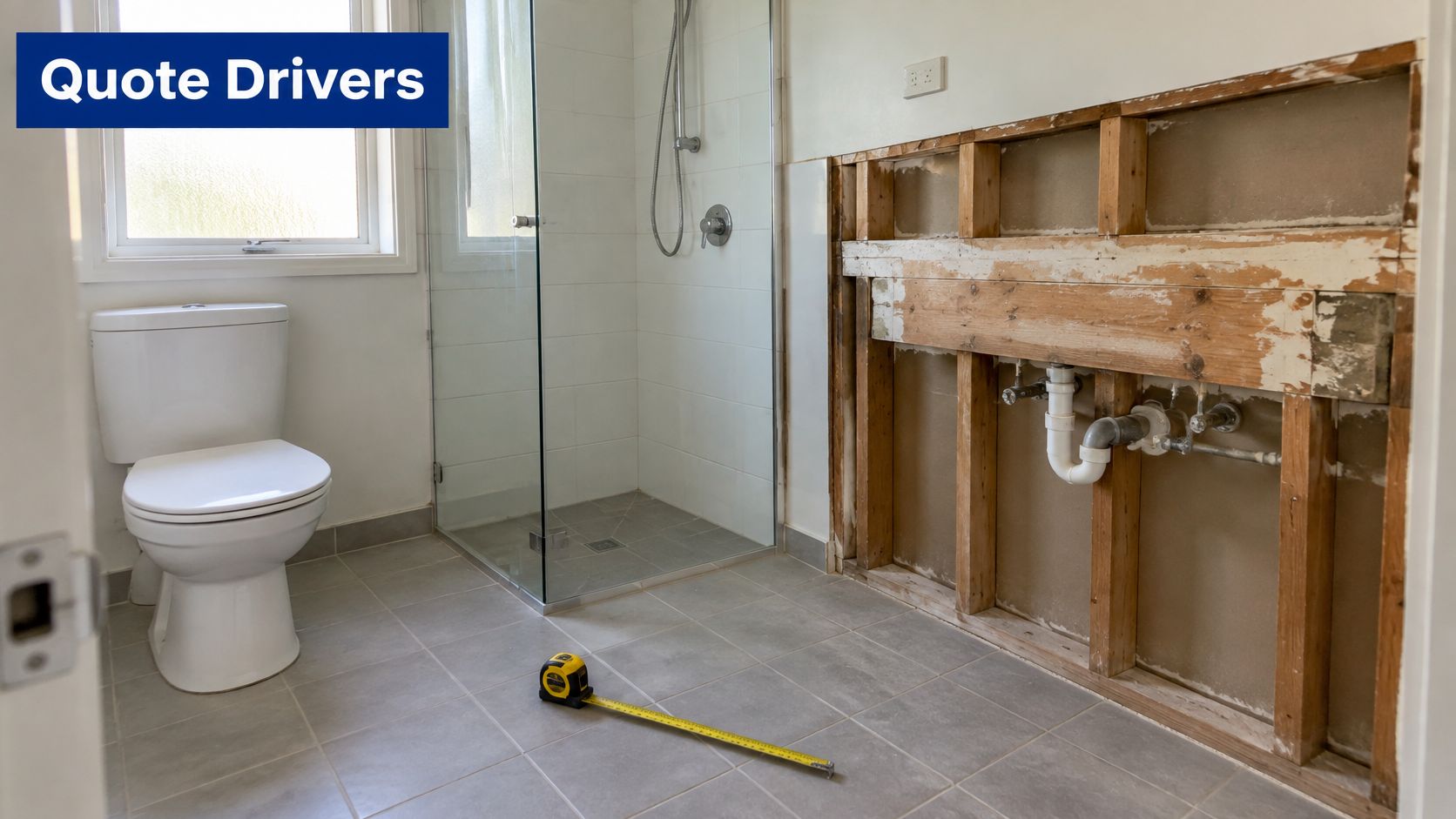
The ranking that matters more than floor area, ordered by how far each driver moves a quote:
| Driver | Direction | Why it moves the quote |
|---|---|---|
| Layout change | Raises | New waste and water runs, extra demolition and reinstatement |
| Undocumented previous alterations | Raises | Surfaces only after strip-out and forces extra rework |
| Building age and access | Raises | Tight access, uneven subfloors and deteriorated plumbing in older housing |
| Finish level | Raises | Tile grade, custom joinery, frameless glass and premium tapware |
| Retained layout with sound plumbing | Lowers | Avoids plumbing rerouting and keeps substrate work to a minimum |
Why the hidden rows catch people out
Building age rarely shows in a pre-quote walkthrough. A 1970s brick veneer in an inner suburb can hide a timber subfloor that has flexed under a leaking shower for a decade, or galvanised supply pipes that fail the moment a new mixer is fitted. Constrained access adds labour hours before a single tile is laid.
Undocumented alterations are worse, because they surface after demolition. A previous owner's DIY waterproofing, a removed wall, a drain that runs uphill to the sewer: each one converts a fixed price into a variation conversation.
Strip-out is the point where those risks become priced items.
Treat size as one input among several
Floor area still matters. It changes tile quantities, sheeting and labour hours. Scope factors such as layout, fixtures, finishes and plumbing changes drive the price further than a single average does.
A 5 square metre room with a moved toilet and a walk-in shower can outprice a 9 square metre room with everything left in place, because the first job is buying new drainage falls, demolition, waterproofing detailing and tile reinstatement while the second is buying mostly surface work.
Victorian Thresholds and Waterproofing Rules That Shape Your Quote
The cheapest headline quote is rarely the cheapest compliant project. Part of what you pay for is set by regulation, documentation and insurance rather than by tiles or tapware, and a quote that excludes those items isn't cheaper. It is incomplete.
In Victoria, renovation work above $10,000 generally requires a major domestic building contract, and work above $16,000 generally triggers domestic building insurance requirements, as set out in this Victorian bathroom renovation compliance guide. Both thresholds sit squarely inside the Melbourne price bands, which means most full renovations in this city are regulated projects whether the homeowner realises it or not.
What to ask for once you cross each threshold
Above AUD 10,000, ask for a written major domestic building contract that lists the full scope, the payment schedule, the start and completion dates, and the deposit amount. Ask what happens if the scope changes mid-build, because that clause decides how variations get priced.
Above AUD 16,000, ask for evidence of domestic building insurance before work starts, and check the policy names your address and your builder. A certificate of currency is the document you want, not a verbal assurance.
The test: two quotes are only comparable when both list the same regulated work, the same insurances and the same certification.
What applies at any price
Wet-area work is regulated regardless of what the job costs. Waterproofing in a bathroom must be installed to the relevant Australian Standard and certified, and the trades doing the plumbing and electrical work must be licensed for it. Those requirements do not disappear because a job is small or because the quote didn't mention them.
Confirm current thresholds and licensing requirements with Consumer Affairs Victoria or the Building and Plumbing Commission before you sign, since rules change and a contract clause written two years ago may not reflect today's position. If you're weighing up which contractor to invite first, this guide to bathroom renovations in Melbourne covers how to shortlist.
The practical consequence is simple. A quote of AUD 9,500 that omits certification, insurance and waste removal is not a cheaper version of a AUD 12,000 quote. It is a different, smaller job wearing the same name.
Hidden Costs and Contingency to Budget For
A quote prices what the estimator can see. The wall and floor behind the tiles stay hidden until demolition, and in older Melbourne housing they regularly reveal more work. The financial stakes are higher than most guides admit: remedial waterproofing and the associated rework can cost around $6,000 to $14,000, according to a Melbourne bathroom renovation guide.
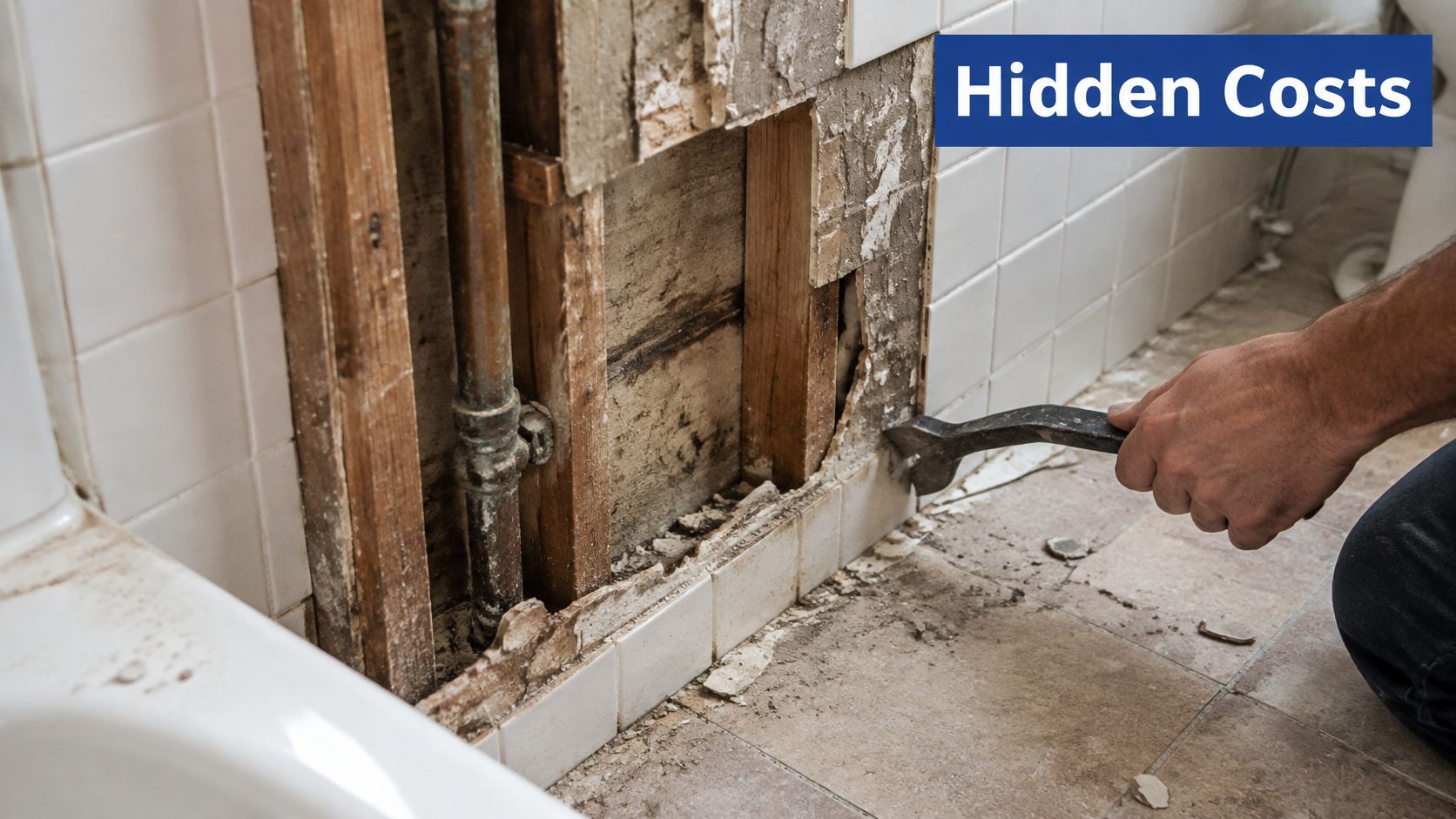
That figure reframes the whole budget conversation. A membrane failure isn't a warranty footnote, it's a second renovation.
What tends to surface after strip-out
- Failed previous waterproofing: a membrane painted over green plasterboard, or no membrane at all behind older showers.
- Deteriorated pipework: corroded galvanised supply lines or a waste pipe patched with tape.
- Uneven or soft subfloor: particleboard that swells and crumbles where water has sat for years.
- Asbestos in sheeting or adhesives: common in older wet areas and requiring testing before removal, not after.
- Constrained access: narrow stairwells and shared driveways in inner and middle-ring housing that slow every trade.
Match the contingency to the scope tier
| Scope tier | Plumbing exposure | Waterproofing and substrate | Hidden-condition risk |
|---|---|---|---|
| Cosmetic refresh (new vanity, tapware, paint) | Low | Existing membrane left in place, condition unverified | Low |
| Same-layout full renovation | Moderate | Full waterproofing and substrate work | Moderate |
| Layout-change renovation | High | Full waterproofing, substrate and new penetrations | High |
Keeping the layout lowers plumbing exposure. It does not lower waterproofing, substrate, ventilation or compliance exposure, because the wet-area envelope still has to be rebuilt to current standards. That distinction is where a lot of budgeting goes wrong.
Label the allowance instead of adding a percentage
An unexplained contingency invites an argument. Five labelled allowances invite a conversation.
Set aside separate amounts for investigation (a plumber's camera on the drain, an asbestos test), demolition surprises, plumbing relocation, substrate repair and waterproofing remediation. Write them into the quote with a line stating who authorises their use and what evidence triggers a claim.
A contingency with a label and an approval rule gets spent on the problem. A contingency that is just a percentage gets spent on nothing, then asked for again later.
Keep the allowance visible rather than burying it in the labour rate. Our list of common bathroom renovation mistakes covers the ones that push a modest job into a second round of work.
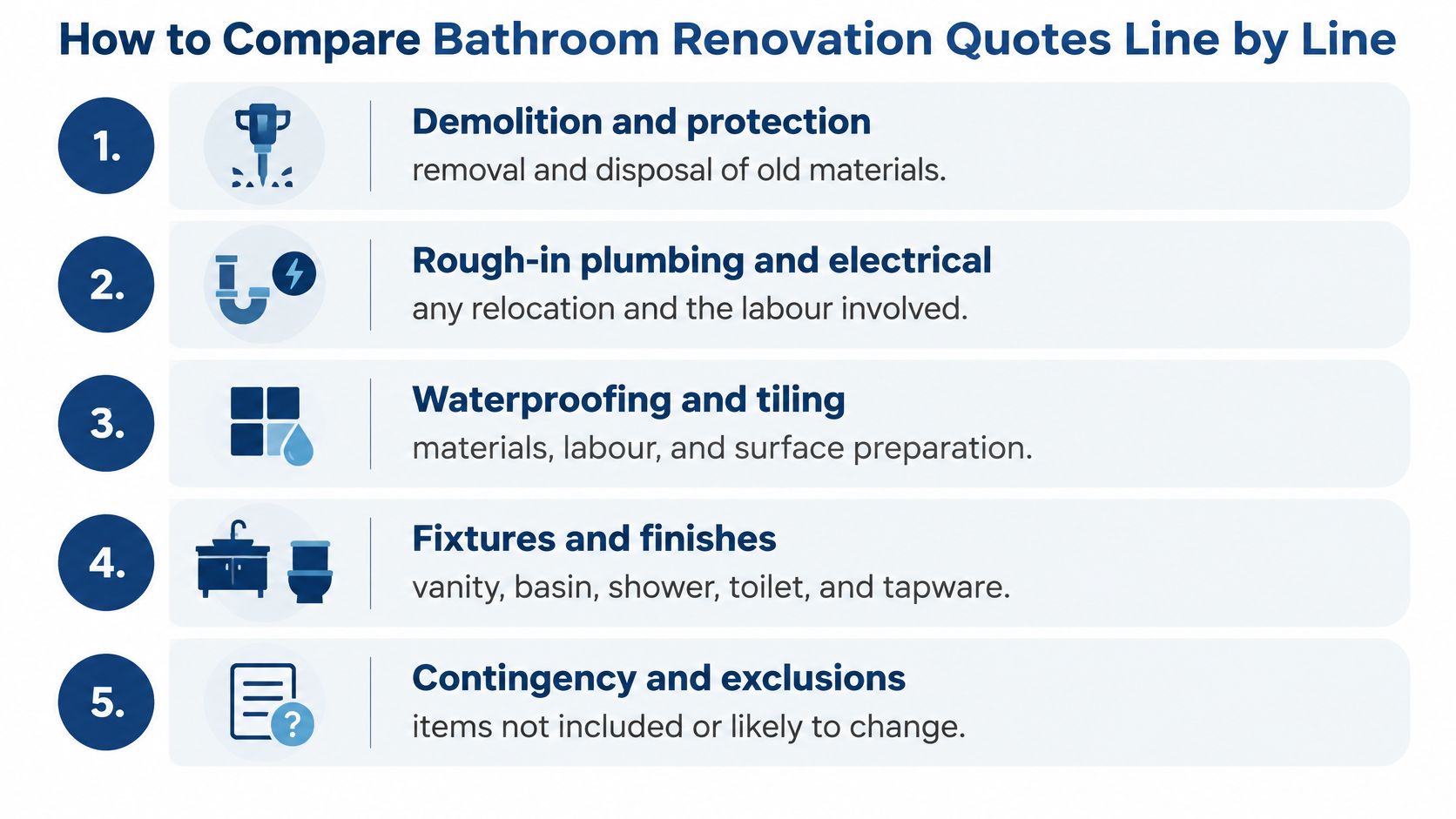
How to Compare Bathroom Renovation Quotes Line by Line
The comparison rule is blunt. Ask every contractor for the same eleven line items, then compare totals only where the scopes match.
- Demolition and protection. Tiles, screed and old fittings removed, plus floor protection for the rest of the house and disposal of the waste.
- Rough-in plumbing and electrical. Any relocation of a waste pipe, water run, GPO or exhaust fan listed as its own line.
- Fit-off plumbing and electrical. Taps, shower, toilet and fixtures installed and connected.
- Waterproofing. The membrane system named, substrate preparation described, junctions and flashing detailed, and evidence of compliance with AS 3740:2021 supplied.
- Tiling supply and installation. Tile size, setting-out, feature walls and grout.
- Cabinetry and vanity. Supplied, delivered and installed, or excluded and listed as an owner-supplied item.
- Glazing and screens. Frameless, semi-frameless or framed, with thickness.
- Ventilation and certification. Exhaust fan ducted to outside, plus the compliance certificates for plumbing, electrical and waterproofing.
- Waste removal and site clean. Skip hire and tip fees, which disappear from cheap quotes and reappear on invoices.
- Insurance, contract and administration. The building contract, domestic building insurance and any permit administration.
- A labelled contingency. Named allowances with an approval rule.
Judge waterproofing by specification, not price per square metre
Australian wet-area requirements specify that shower walls generally need waterproofing to at least 1,800 mm above the floor substrate, while walls adjoining a bath need protection to at least 150 mm above the bath rim, and floor-to-wall junctions need correctly formed flashing, as this Australian bathroom build guide sets out. Indicative pricing sits at roughly AUD 800–2,000 for standard bathroom waterproofing, depending on complexity, substrate condition, shower configuration and floor construction.
The membrane is concealed for the life of the renovation, so a low line item buys you nothing you can inspect later. Ask which system, who holds the certification, and how the junctions are formed. Cheaper preparation or poorly treated junctions let water migrate behind the finishes, which shows up as swelling, mould, structural deterioration and tile failure.
Apply the same rule to the whole document
If one quote lists nine items and another lists eleven, the lower total is meaningless until you add the two missing lines. The same applies to any bathroom renovations price guide you read, including this one: a range is only ever as good as the scope written underneath it.
Confirm Your Budget Before You Request a Quote
Set your numbers before anyone walks through the door, then hold every conversation to them. A quote measured against a fixed scope exposes padding and omissions quickly; a figure negotiated on the spot tends to grow around whatever the contractor assumes you can spend.
- Scope tier: small ensuite, mid-range full bathroom or full Melbourne renovation, from the first table.
- Budget band: the range attached to that tier, adjusted for anything you already know is premium.
- Labelled contingency: separate allowances for investigation, demolition surprises, plumbing relocation, substrate repair and waterproofing remediation.
That last line does the most work. Contingency labelled by cause is a budget; contingency listed as one lump sum is a blank space the final invoice can fill. If a quote shows a single "extras" figure, ask what it is assumed to cover before you sign.
Elite Bathroom Renovations Melbourne is one local option for readers ready to compare. Its stated team covers tilers, plasterers, electricians, plumbers, painters and cabinetmakers, and it describes itself as licensed, bonded and insured, working to the applicable Australian Standards, with 10-year waterproofing, 10-year structural and 2-year minor defect coverage. Ask for the insurance certificate and have each coverage term written into the quote before work begins.
Bring the planned scope, the age of the bathroom and any problems you already know about to the site visit. Known defects belong in the fixed price and unknowns belong in contingency. A contractor who keeps those two apart on paper is showing you how the invoice will behave once the wall opens up.
The team of tilers, plumbers, electricians and cabinetmakers at Elite Bathroom Renovations Melbourne can quote your project. Visit Elite Bathroom Renovations Melbourne to book a site visit and check the quote against the checklist above.
