

For a standard 5–6 m² Melbourne bathroom with the existing layout kept, allow approximately $20,000–$32,000 for a mid-range renovation. Premium projects commonly reach $35,000–$60,000, while a $5,000–$10,000 cosmetic refresh is only suitable when the existing wet area is sound.
You might already have tiles saved on your phone, a vanity shortlisted and competing quotes that seem to describe completely different jobs. The difficult part isn't choosing a tap. It's working out whether each contractor has allowed for the same construction work.
Bathroom renovations prices are most useful when they're grouped by scope, not reduced to a single average. Every range below is indicative until a contractor inspects your bathroom and supplies an itemised quote.
Table of Contents
- Melbourne Bathroom Renovation Prices by Scope
- What Pushes a Bathroom Price Up or Down
- Where the Money Goes in a Typical Quote
- Hidden Costs and How to Budget for Them
- How to Compare Contractor Quotes Side by Side
- Set Your Scope and Budget Before You Request Quotes
Melbourne Bathroom Renovation Prices by Scope
Start by deciding whether you're refreshing an intact room or rebuilding a wet area. Those are different projects, even if the finished photographs look similar.
The Co-architecture Melbourne bathroom cost guide puts a standard 5–6 m² mid-range renovation at approximately $20,000–$32,000, premium projects at $35,000–$60,000, and limited cosmetic refreshes at roughly $5,000–$10,000. These are budgeting categories, not guaranteed quotes or a promise that every project within them includes identical work.
Match the allowance to the construction
| Scope | Typical Melbourne range | What it covers | Best fit |
|---|---|---|---|
| Cosmetic refresh | $5,000–$10,000 | Selected fittings, vanity, paint and accessories | Sound wet area and no layout change |
| Mid-range, layout unchanged | $20,000–$32,000 | Standard 5–6 m² room with new fixtures, tiling and waterproofing in existing positions | Family bathroom replacements without redesigning the room |
| Premium, layout unchanged | $35,000–$60,000 | Higher-specification fittings and finishes, more demanding tiling and joinery | Upgraded finishes and features |
| Structural or full layout change | Site-specific allowance after inspection | Relocated fixtures, structural alterations or window changes | Projects requiring a different layout or substantial building work |
A cosmetic refresh leaves the underlying wet-area construction intact. Replacing a mirror, painting suitable surfaces and updating selected fittings can improve the room without rebuilding it. Removing shower tiles or disturbing the waterproofing can move the project out of this category.
A mid-range replacement is a construction project rather than a shopping list. You're paying for removal, preparation and coordinated installation as well as the visible products. Keeping the fixture positions makes the scope easier to define, but doesn't guarantee that the concealed materials are reusable.
For a premium bathroom, ask what creates the premium. Custom cabinetry, specialist tile detailing and upgraded fittings should appear in the specification. An expensive quote with vague selections isn't a clearly defined premium renovation.
Structural and full-layout work needs its own assessment. Don't assume the premium range automatically includes wall removal, window alterations or every plumbing relocation.
Practical rule: Classify the building work before choosing the finishes. A discounted vanity doesn't turn a wet-area rebuild into a cosmetic refresh.
Check the room before choosing a category
A national average can combine partial upgrades, complete replacements and extensive alterations. That makes it a poor substitute for a quote describing your actual bathroom.
Before requesting prices, record:
- Fixture positions: Are the toilet, shower and basin staying put?
- Wet-area condition: Is there leakage, swelling, loose tiling or another reason to investigate the underlying construction?
- Room dimensions: Is yours a compact bathroom, a standard family room or a larger space?
Treat your answers as a starting brief, not a self-issued assessment that the waterproofing is sound.
What Pushes a Bathroom Price Up or Down
Two bathrooms can have the same floor area and identical tiles but require very different amounts of work. The distinction is usually behind the finished surfaces.
The main decisions involve layout, room size, specification and accessibility or structural work. Use this visual to separate product choices from construction requirements.
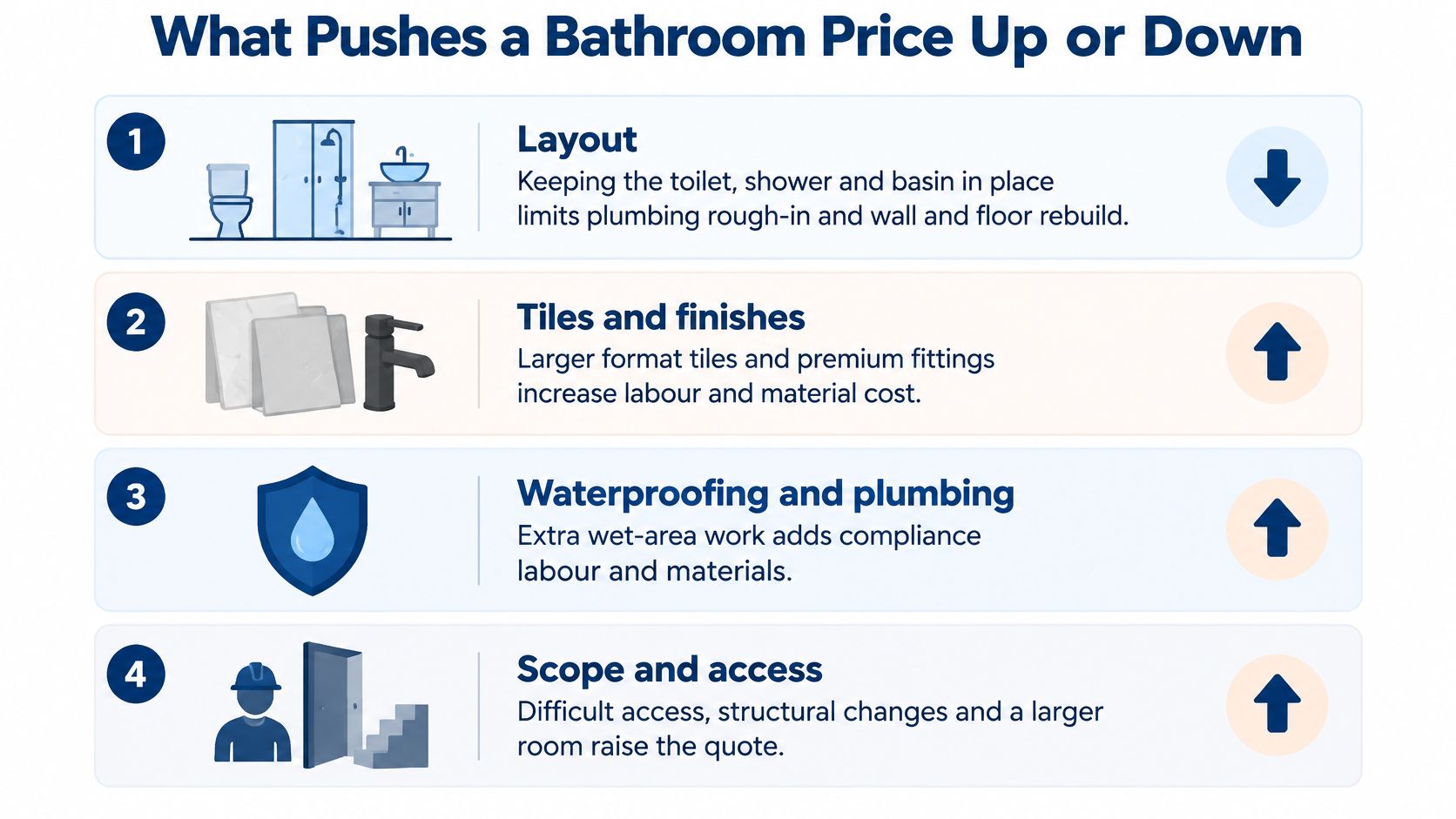
Compare decisions by the work they create
Layout comes first. Moving a toilet can require a different drainage route and access through the floor. Depending on the design, relocating other fixtures can also involve electrical changes, wall reconstruction and additional wet-area detailing.
Room size changes quantities. A larger bathroom can require more tiles, preparation and installation labour, but floor area alone doesn't describe the difficulty. A small room with awkward drainage can be more involved than a larger room with straightforward access.
| Scope decision | Effect on price | Why it moves cost |
|---|---|---|
| Keep toilet, shower and basin where they are | Lowest of the layout options | Limits plumbing rough-in and wall and floor reconstruction |
| Relocate one fixture | Additional allowance requiring inspection | Adds service relocation and associated making-good work |
| Relocate toilet, shower and basin together | High scope exposure | Increases demolition, drainage, electrical, waterproofing and finishing work |
| Standard room versus a larger room | Larger room generally needs a higher quantity allowance | Changes tiling, waterproofing and labour quantities |
| Higher-specification fittings and finishes | Can be smaller than a major scope change | Product prices alone don't describe the installation work |
Specification comes next. Compare actual tapware models, vanity dimensions, tile formats and shower-screen details. A large-format tile may need careful substrate preparation and handling; an inexpensive tile in a labour-intensive pattern can still produce a substantial installation bill.
Accessibility and structural changes need separate descriptions. A step-free shower may require changes to floor levels and drainage. Grab rails need suitable support, while window alterations and wall changes need assessment beyond the fixture schedule.
A like-for-like room comparison
Say you're comparing two hypothetical bathrooms of equal size with the same porcelain tiles and vanity. In the first, the toilet remains in place; in the second, it moves to the opposite wall.
The second contractor must establish a drainage route, check access and price the affected floor work. The unchanged-layout allowance isn't a reliable cap for that redesign, even though the finished rooms use the same products.
Older homes can also reveal uneven floors, out-of-plumb walls and deteriorated pipework. Apartments add practical questions about lift bookings, delivery routes and permitted working hours.
You control layout and selections before signing. You can't fully control what a contractor finds behind existing finishes.
Ask contractors to distinguish those controllable choices from concealed-condition allowances rather than combining everything into an unexplained contingency.
Where the Money Goes in a Typical Quote
An itemised quote should describe how the contractor will turn the existing room into a finished bathroom. It shouldn't just list fixtures and leave the technical work inside a single labour figure.
A site measure helps the contractor identify access, dimensions and construction details before pricing.
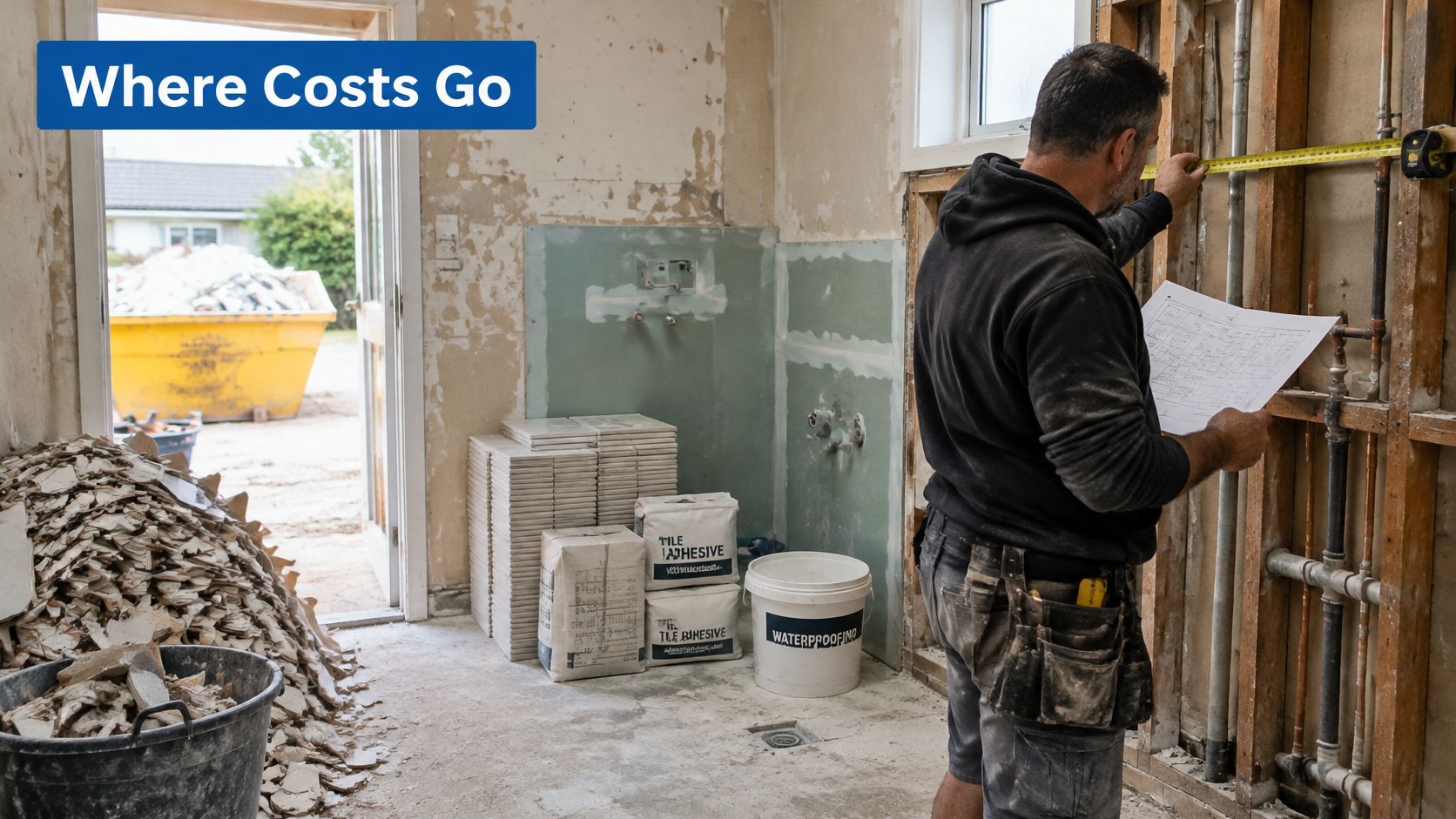
Separate preparation from installation
The What's the Damage Melbourne trade-cost breakdown gives indicative ranges of $1,050–$3,150 for demolition and disposal, $2,100–$5,250 for plumbing rough-in, $735–$3,675 for waterproofing, and $2,950–$7,900 for supplied-and-installed floor and wall tiling. Its typical combination totals about $15,660, before some electrical, painting, project-management and higher-specification selections.
| Quote line item | Indicative range | Question to ask |
|---|---|---|
| Demolition and disposal | $1,050–$3,150 | Is waste removal included? |
| Plumbing rough-in | $2,100–$5,250 | Are any pipe relocations priced separately? |
| Waterproofing | $735–$3,675 | Are substrate repairs included or set as an allowance? |
| Floor and wall tiling, supplied and installed | $2,950–$7,900 | Is tile supply a fixed price or an allowance? |
| Typical subtotal of these items | About $15,660 | Which electrical, painting and project-management costs remain? |
Demolition and disposal covers stripping the room and removing unwanted materials. Ask whether the contractor has included protection for the route through your home, waste handling and the condition in which the room will be handed to following trades.
Plumbing rough-in means the supply and drainage work installed before the finished surfaces and fittings. Clarify whether the quote includes both this concealed work and final fixture connection, rather than assuming the word plumbing covers everything.
Waterproofing needs a defined substrate and system. Shower geometry, penetrations, floor falls and wall coverage affect the work, while damaged backing materials may need replacement before a membrane can be installed.
Check the boundaries of each allowance
For tiling, specify the selected tile, installation pattern, tiled wall extent, edge treatment and niches. The publisher's guide to tiling works for Melbourne bathroom renovations is a useful companion when preparing that scope.
The video below provides an additional visual reference for discussing renovation work.
Don't calculate a project price by automatically adding every minimum or maximum in a guide. The subtotal above represents a typical combination, not the arithmetic midpoint or the complete bathroom contract.
Before comparing totals, check these boundaries:
- Tax treatment: Does the quoted total include GST?
- Damaged substrates: Is rectification included, excluded or provisional?
- Finishing work: Who supplies painting, electrical fit-off, sealant and final cleaning?
- Waste removal: Is disposal included once, rather than omitted or duplicated?
An apparently cheap quote may stop before the room is complete.
Hidden Costs and How to Budget for Them
The lowest contract figure isn't necessarily the lowest final cost. Money magazine's coverage of renovation costs cites national renovation research reporting an average project cost overrun of 62%, alongside homeowner examples of $40,000 estimates exceeding $60,000 after structural problems were discovered.
Those are broader renovation examples, not a forecast for your Melbourne bathroom. They demonstrate why an estimate needs clearly stated assumptions and an agreed process for discoveries.
Name the uncertain work
A contractor may not be able to inspect everything before demolition. That uncertainty should be recorded rather than hidden inside confident wording.
Ask about:
- Rotten subfloor: What happens if the floor beneath the shower requires replacement?
- Damaged substrates: Does the allowance cover removing failed backing materials and installing a suitable replacement?
- Suspected asbestos-containing materials: Who arranges assessment and appropriate removal if required?
- Concealed pipe damage: How will the plumber price repairs that aren't visible during inspection?
A provisional sum is an allowance for work whose scope isn't fully established. A prime cost allowance generally concerns an item not finally selected or priced, such as a fixture. Ask the contractor to explain how adjustments and any applicable margins will be calculated.
Budget safeguard: Require the contractor to describe a variation, price it and obtain your written approval before proceeding, except where an agreed urgent-safety procedure applies.
Build a reserve around the risks
Keep a variation reserve separate from the contract price. Its size should reflect the building's condition, inspection access and unresolved scope, not a universal percentage that ignores what you're renovating.
Don't spend that reserve on upgraded tapware before demolition. If an inspection identifies doubtful flooring or old services, resolve the likely repair method and allowance first.
Your household may also face expenses outside the building contract. Alternative bathroom access, additional cleaning, storage and reinstatement after disruption deserve their own budget line.
Use this structure:
- Fixed contract: Work and selections that are fully defined.
- Allowances: Identified items awaiting final scope or selection.
- Variation reserve: Money retained for unforeseen work.
- Personal costs: Expenses caused by losing access to the bathroom.
A written brief for bathroom renovations in Melbourne should distinguish these categories before you accept a price. That separation lets you see whether a cheaper offer reflects efficiency, a reduced scope or more uncertainty transferred to you.
How to Compare Contractor Quotes Side by Side
Put each quote beside the same scope list and fixture schedule. Mark every omission, allowance and exclusion before comparing the totals.
Use the checklist as a first pass, then investigate the contractual protections behind each offer.
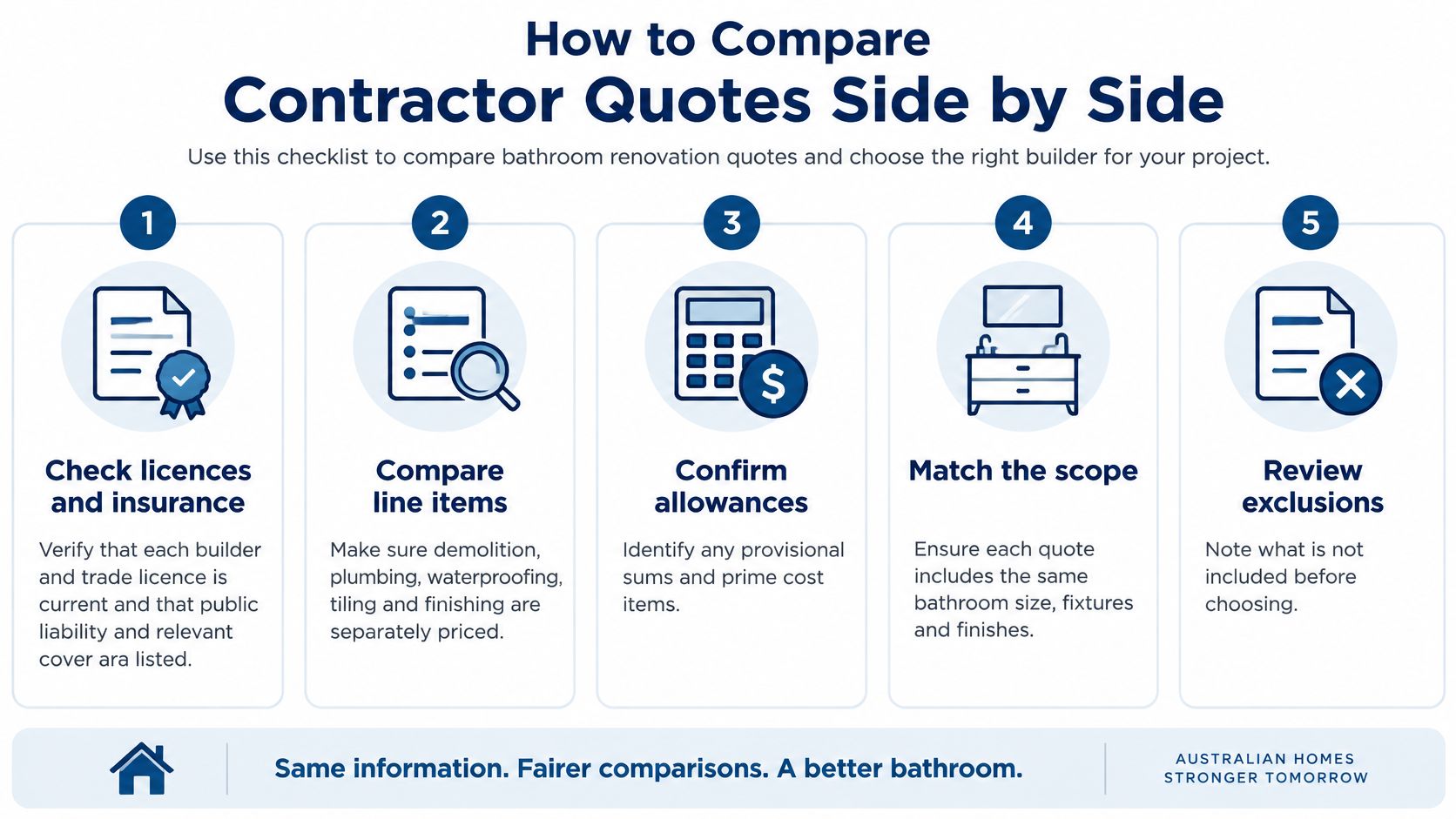
Audit the scope and the contractor
Verify licences and insurance. Check the contracting entity's registration and the relevant trade licences, then request evidence of public liability and applicable cover. Names on the contract, insurance documents and payment details should be consistent.
Normalise the quote lines. Confirm that each offer covers the same demolition, plumbing, waterproofing, tiling and finishing work. A fixed price for a smaller scope isn't directly comparable with a more complete proposal containing transparent allowances.
Agree how variations work. Ask who can authorise changes, how labour and materials are priced, and whether the contractor adds a margin. Written approval prevents a conversation on site from becoming an unexpected invoice.
Tie progress payments to identifiable stages. Define what completed work triggers each payment and clarify the deposit arrangements before signing. Avoid paying ahead of completed work merely because the contractor requests cash flow assistance.
Confirm warranties and Victorian protections. Obtain written warranty terms and ask which statutory protections and domestic building insurance requirements apply to your particular contract. Don't assume a contractor's advertised guarantee replaces legal protections or covers every type of defect.
Assess completion risk as part of the price
Contractor stability matters because an unfinished bathroom can leave you paying for both recovery work and extended disruption. Going Rate's Australian renovation analysis reports 2,832 building-company insolvencies in FY2024, a 28% annual increase, and estimated Australian demand of about 244,000 bathrooms across 2024–25.
Those historical national figures don't predict whether an individual contractor will finish your job. They do justify checking who will perform the work, whether key trades are scheduled and what happens if the builder can't continue.
Ask for a realistic programme covering selections, deliveries, site work and handover. A start date means little if the shower screen, vanity or required trades haven't been coordinated.
For any Melbourne bathroom renovation proposal, assess the total cost of ownership rather than only the acceptance price:
- Contract and variations: How much is firm, and how much remains exposed?
- Loss of use: What household arrangements will you need during the work?
- Maintenance: Are fittings serviceable and replacement parts identifiable?
- Warranty security: Who handles defects, and what documentation will you receive?
A slightly higher, clearly defined offer can be preferable to a lower figure with unresolved scope and weak completion arrangements.
Set Your Scope and Budget Before You Request Quotes
Place your project in the appropriate scope category before contacting contractors. Record whether the fixtures stay in position, whether the wet area needs rebuilding and whether the room's dimensions or proposed features create additional work.
Set a target budget range, including your reserve and personal costs. Keep a separate wish list so optional upgrades don't become confused with essential repairs.
Prepare a brief contractors can price
Use a tape measure to record the room dimensions and photograph the shower, vanity, toilet, doorway and visible damage. Include access information, such as stairs, parking restrictions or apartment delivery arrangements.
Your brief should contain:
- A layout sketch: Mark existing fixtures and proposed changes.
- A selection schedule: List actual products where chosen, including dimensions and model references.
- A finish description: Identify tiled areas, tile format, cabinetry and screen requirements.
- Known concerns: Note leaks, soft flooring, previous repairs and inaccessible services.
- A completion scope: State whether painting, disposal, cleaning and reinstatement are required.
Request comparable written offers
Send the same brief to several contractors and request itemised quotes. Ask them to identify assumptions, provisional work, exclusions, GST treatment and warranty terms in writing rather than filling gaps with verbal assurances.
Review proposed alternatives separately. If one contractor suggests retaining a wall or changing a fixture position, request a clearly described option so you can compare the original scope fairly.
Book a site inspection before committing to the budget. That's where a contractor can assess visible conditions, identify what still requires investigation and turn a broad allowance into a properly defined proposal.
Elite Bathroom Renovations Melbourne offers bathroom renovation services with a team covering plumbing, electrical, tiling, plastering, painting and cabinetry. Visit the team to arrange a discussion and site inspection, bringing your layout sketch, photographs and selections so you can request an itemised quote matched to your scope and budget.
